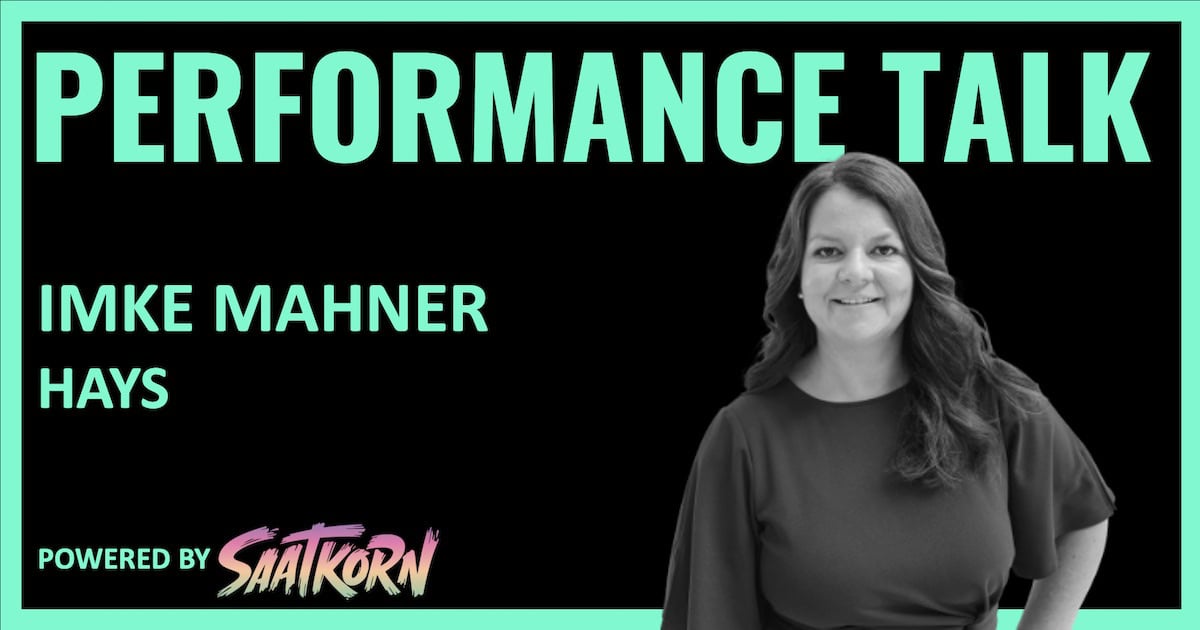
Hays HR Report 2026: Interview with Imke Mahner
Hays HR Report: Why Is Performance the Focus Topic for 2026, Imke Mahner?
German Version below
The Hays HR Report is exciting every year. On the one hand, because of its annual focus topic; on the other, because of the long-term perspective it offers since the report’s first publication. As always, this is reason enough to reach out to Hays and ask which topics are particularly compelling this year. To my great delight, Hays Chief People Officer Imke Mahner answered my questions. Let’s get started:
SAATKORN: Imke, please introduce yourself briefly to SAATKORN readers.
I’d be happy to. My name is Imke Mahner, and as Chief People Officer at Hays, I’m responsible for the People & Culture division for Central Europe, the Middle East, and Africa. Previously, I worked in regional and global HR roles at the car rental company Avis and spent nearly a decade at the technology consulting firm Accenture. I studied psychology in England.
SAATKORN: The Hays HR Report 2026 focuses on the topic of performance. Why this focus at this particular time?
In its annual HR Report, Hays always tackles major issues that affect executives, HR managers, and employees alike, but which these stakeholders interpret differently. This usually involves cultural implications. The understanding of performance is currently particularly subject to such cultural shifts. There are very different perspectives and perceptions regarding the state of workplace morale in companies. We have found that two sides often dominate this discussion. One side demands that people perform better, while the other side complains that they would perform better if the conditions were right. We wanted to delve deeper into these opposing viewpoints and understand how they actually shape the modern understanding of performance today.
SAATKORN: What was the scope of this year’s HR Report, and who was surveyed and when?
We surveyed a total of 907 people. Of these, 61 percent were men and 39 percent were women. In terms of age distribution, the majority are those aged 30 to 39 (24%), 40 to 49 (27%), and 50 to 59 (30%). Among them, 16 percent are representatives of company management. Fifteen percent are HR managers, and 24 percent are employees without managerial responsibility. The largest group by proportion consists of managers from functional departments, at 45 percent.
SAATKORN: Performance is—unsurprisingly—an important issue for companies, but willingness to perform and ability to perform are not the same thing. How do these two components appear in the report?
Yes, exactly. The report defines willingness to perform as the desire to perform. Work ethic is not a given. Willingness to perform is assessed very differently in the HR report: about one-third see it declining, another third see it as stable. Employees attribute declining work ethic primarily to leadership failures, cultural deficits, and a lack of recognition.
By performance capability, we mean how employees can perform—that is, the framework conditions for performance. 27 percent of respondents perceive a decline in performance capability. The main reasons are excessive demands, psychological stress, a lack of development opportunities, and leadership shortcomings. One thing is particularly clear: performance issues rarely stem from a lack of will, but rather from depleted resources. Employees often want to accomplish a lot, but then fail because the workload is simply too high and they feel exhausted and burned out.
SAATKORN: To what extent is the topic of leadership linked to both willingness and ability to perform?
Managers are essentially the linchpin determining whether employees want to perform and whether they are able to do so. Managers’ behavior is largely responsible for whether teams are motivated, feel valued, and are naturally willing to go the extra mile during economically difficult times. Managers are also responsible for recognizing potential in their employees and for developing and fostering it.
SAATKORN: What implications does this have for HR?
Because leadership failures are cited in the report as a key reason for both declining willingness to perform and declining ability to perform, HR must better position and support leadership as an enabler of performance. HR should strive to better balance performance requirements and performance support for managers. This can be achieved, for example, by designing and conducting performance and development reviews in collaboration with employees. The management perspective should be aligned more closely with the employee perspective.
SAATKORN: It’s interesting that, overall and unsurprisingly, performance is rated as important, but only 40% of the surveyed companies actually measure performance. Why is that?
We couldn’t determine that exactly in the report. Since we surveyed both large and small companies, we assume that smaller organizations more often lack the standards, systems, or resources for formalized performance measurement. Measuring performance fairly is no trivial matter.
SAATKORN: Finally, a question regarding the long-term perspective. I find it astonishing that for many years now, the two topics of employee recruitment and retention have consistently ranked in the top two spots. At least this year, I would have expected “flexible work organization” to be at the top. This is against the backdrop of the uncertain economic situation in Germany that has persisted for years. How is it that retention and recruitment continue to lead by a considerable margin?
Employee retention and recruitment are at the top because they are the most immediate response to the ongoing pressure in the labor market and regarding workforce availability. When there is a shortage of staff or knowledge leaves the organization, the business is directly affected. This is precisely why employee retention is described as a key area of focus in the long term, while recruitment is once again gaining significant importance. For 2026, retention is by far the most important HR trend at 55 percent, with recruitment following in second place at 34 percent.
SAATKORN: Thank you, Imke, for answering our questions about the Hays HR Report 2026, and we wish you continued enjoyment and success with and at Hays!
Further links
- Imke Mahner on LinkedIn
- Hays HR Report 2026 Download
Hays HR-Report: Warum ist Leistung 2026 Fokusthema, IMKE MAHNER?
Der Hays HR-Report ist jedes Jahr wieder auf’s Neue spannend. Einerseits wegen des jeweiligen Fokus-Themas, andererseits wegen der Langzeitbetrachtung seit erstmaligem Erscheinen des Reports. Wie jedes Jahr Grund genug, einmal bei Hays nachzurfragen, welche Themen in diesem Jahr besonders spannend sind. Zu meiner großen Freude hat Hays Chief People Officer Imke Mahner meine Fragen beantwortet. Auf geht’s:
SAATKORN: Imke, bitte stelle Dich den SAATKORN Leser:innen doch kurz vor.
Sehr gerne. Mein Name ist Imke Mahner und ich verantworte als Personalvorständin bei Hays den Bereich People & Culture für Zentraleuropa, den mittleren Osten und Afrika. Zuvor habe ich in regionalen und globalen HR-Funktionen bei der Autovermieter Avis sowie fast ein Jahrzehnt bei der Technologieberatung Accenture gearbeitet. Ich habe Psychologie in England studiert.
SAATKORN: Der Hays HR-Report 2026 dreht sich um das Thema Leistung. Warum dieser Schwerpunkt zu diesem Zeitpunkt?
Im jährlichen HR-Report nimmt sich Hays immer große Themen vor, die Geschäftsleitungen, Personalverantwortliche und Mitarbeitende gleichermaßen betreffen, die diese Akteure aber unterschiedlich einordnen. Dabei geht es meist um kulturelle Implikationen. Das Leistungsverständnis ist aktuell solchen kulturellen Veränderungen besonders unterworfen. Es gibt sehr unterschiedliche Perspektiven und Wahrnehmungen dazu, wie es um die Arbeitsmoral in Unternehmen bestellt ist. Wir haben festgestellt, dass dabei häufig zwei Seiten dominieren. Die eine Seite fordert, dass Menschen mehr leisten müssen, während die andere Seite beklagt, dass sie mehr leisten würde, wenn die Rahmenbedingungen stimmen. Wir wollten diesen Fronten stärker auf den Grund gehen und verstehen, wie sie das moderne Leistungsverständnis heute eigentlich zusammensetzt.
SAATKORN: Was war das Setting des diesjährigen HR-Reports, wer wurde wann dazu befragt?
Wir haben insgesamt 907 Personen befragt. Davon 61 Prozent Männer und 39 Prozent Frauen. Im Alterssplit stellen das Gros die 30- bis 39-Jährigen (24 %), die 40- bis 49-Jährigen (27 %) und die 50- bis 59-Jährigen (30 %) dar. Unter ihnen sind zu 16 Prozent Vertreterinnen und Vertreter von Unternehmensleitungen. 15 Prozent sind Führungskräfte im HR-Bereich, 24 Prozent Mit-arbeitende ohne Führungsverantwortung. Die anteilig größte Gruppe stellen Führungskräfte aus Fachabteilungen mit 45 Prozent dar.
SAATKORN: Leistung ist für Unternehmen – wenig überraschend – ein wichtiges Thema, aber Leistungsbereitschaft und -fähigkeit sind nicht dasselbe. Wie stellen sich diese beiden Komponenten im Report dar?
Ja genau. Unter Leistungsbereitschaft versteht der Report, leisten zu wollen. Arbeitsmoral ist kein Selbstläufer. Die Leistungsbereitschaft wird im HR-Report sehr unterschiedlich eingeschätzt: Rund ein Drittel sieht sie sinken, ein weiteres Drittel als stabil. Mitarbeitende führen eine nachlassende Arbeitsmoral vor allem auf Führungsfehler, kulturelle Defizite und fehlende Anerkennung zurück.
Unter Leistungsfähigkeit subsummieren wir wie die Mitarbeitenden leisten können, also die Rahmenbedingungen für Leistung. 27 Prozent der Befragten nehmen eine gesunkene Leistungsfähigkeit wahr. Hauptgründe sind Überforderung, psychische Belastungen, fehlende Entwicklungsmöglichkeiten und Führungsdefizite. Besonders deutlich wird: Leistungsprobleme entstehen selten aus mangelndem Willen, sondern aus erschöpften Ressourcen. Mitarbeiter wollen häufig vieles tun, scheitern dann aber daran, dass die Arbeitsdichte doch sehr hoch ist und sie sich erschöpft und ausgebrannt fühlen.
SAATKORN: Inwiefern hängt das Thema Führung sowohl mit der Leistungsbereitschaft als auch -fähigkeit zusammen?
Die Führungskräfte sind quasi der Dreh- und Angelpunkt dafür, ob Mitarbeiter etwas leisten wollen und auch, ob sie es können. Das Verhalten der Führungskräfte ist maßgeblich dafür verantwortlich, ob Teams motiviert sind, sich wertgeschätzt fühlen und natürlich dann auch bereit sind, in wirtschaftlich schwierigen Zeiten eine Extrameile zu gehen. Führungskräfte sind ebenfalls dafür verantwortlich, Potenziale bei ihren Mitarbeitern zu erkennen und diese weiterzuentwickeln und zu fördern.
SAATKORN: Welche Handlungsimplikationen ergeben sich daraus für HR?
Weil Führungsfehler im Report sowohl als wichtiger Grund für sinkende Leistungsbereitschaft als auch für sinkende Leistungsfähigkeit genannt werden, muss HR Führung stärker als Enabler für Leistung qualifizieren und unterstützen. HR sollte versuchen, Leistungsanforderung und Leistungsförderung für die Führungskräfte besser auszubalancieren. Das geht beispielsweise, indem man Performance- und Entwicklungsgespräche mit den Mitarbeitern zusammen denkt und durchführt. Die Führungsperspektive sollte näher an der Mitarbeiterperspektive ausgerichtet werden.
SAATKORN: Interessant ist, dass Leistung in Summe und wenig überraschend als wichtig eingestuft wird, aber nur 40% der befragten Unternehmen Leistung auch messen. Woran liegt das?
Das konnten wir im Report nicht ganz genau feststellen. Da wir große Unternehmen ebenso wie kleine befragt haben, gehen wir davon aus, dass in kleineren Organisationen häufiger Standards, Systeme oder Ressourcen für formalisierte Leistungsmessung fehlen. Die Leistung fair zu messen ist nicht trivial.
SAATKORN: Zu guter Letzt noch eine Frage zur Langzeitbetrachtung. Ich finde es erstaunlich, dass sich seit vielen Jahren die beiden Themen Mitarbeitendengewinnung und -bindung immer auf den beiden vorderen Plätzen befinden. Zumindest in diesem Jahr hätte ich damit gerechnet, dass die “Arbeitsorganisation flexibel gestalten” an vorderer Stelle liegt. Dies vor dem Hintergrund der seit Jahren unsicheren Wirtschaftssituation in Deutschland. Wie kommt es, dass Bindung und Gewinnung nach wie vor und mit ziemlichem Abstand vorne liegen?
Mitarbeiterbindung und -gewinnung liegen vorne, weil sie die unmittelbarste Antwort auf den anhaltenden Arbeitsmarkt- und Verfügbarkeitsdruck sind. Wenn Personal fehlt oder Wissen abwandert, ist das Geschäft direkt betroffen. Genau deshalb wird Mitarbeiterbindung in der Langzeitbetrachtung als zentrales Handlungsfeld beschrieben, während Mitarbeitergewinnung wieder stark an Bedeutung gewinnt. Für 2026 ist Bindung mit 55 Prozent der mit Abstand wichtigste HR-Trend, Gewinnung folgt mit 34 Prozent auf Rang zwei.
SAATKORN: Danke, liebe Imke für die Beantwortung der Fragen zum Hays HR-Report 2026 und weiterhin viel Spaß und Erfolg mit und bei Hays!
Weiterführende Links
- Imke Mahner auf LinkedIn
- Hays HR-Report 2026 zum Download