

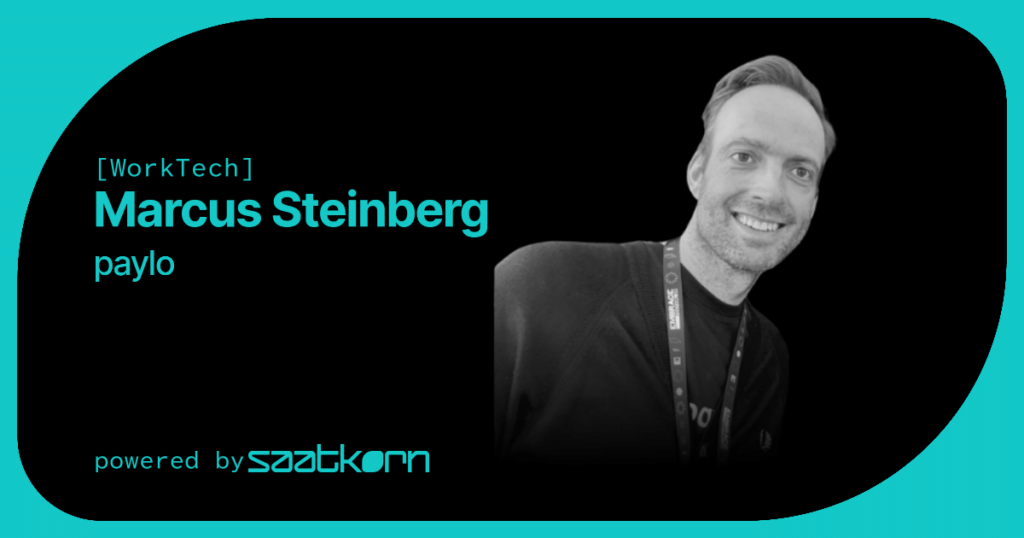
How paylo is disrupting employee benefits with just 3 people and 10 agents
As part of the SAATKORN HR Start-up Series, I’d like to introduce you to paylo today. This Berlin-based company is revolutionising the approach to employee benefits – with just 3 staff members and 10 agents – it’s incredibly exciting! I had the opportunity to speak to co-founder Marcus Steinberg (on the left in the photo). Let’s get started:
SAATKORN: Please introduce yourself to SAATKORN readers!
I’m Marcus Steinberg, founder and managing director of paylo. I started out in the traditional way in consultancy in Berlin, until the first big wave of start-ups came along – that’s when I jumped on board and haven’t looked back since. I first set up a business within the CHECK24 ecosystem and later also at BCG-DV. With paylo, I came across a problem for the first time that isn’t down to the market, but to implementation: the tax benefit exists — it’s just not accessible to many people.
SAATKORN: What’s the story behind the founding of your HR start-up?
Actually, there are two founding stories. The first is in the commercial register: summer 2024, with a traditional tech stack, focusing on meal allowances. The second is the one that’s been running since November 2025. I was at Slush in Helsinki. There, I saw what’s now possible in product development, and that led me over Christmas to an unpleasant but, in hindsight, very productive decision: We scrapped the entire stack and, in January 2026, together with Mark Dzulko, started completely from scratch under the name paylo. Looking back, taking that break and the subsequent fresh start were the best decisions of the year, even if it felt incredibly tough at the time.
50 tax benefits – and a problem with implementation
SAATKORN: What is your mission – what problem are you aiming to solve?
German tax law provides for around fifty mechanisms through which employers can give their staff more take-home pay from their gross salary, either tax-free or subject to a flat-rate tax. The typical SME makes use of only a very limited number of these. Not out of ignorance – but because there’s a verification process standing between them and the tax benefit: submitting and assessing supporting documents, keeping track of exemption limits, weighing up combination rules. This was too unstructured for traditional software and too expensive to do manually. So the work ended up piling up in HR or with the tax adviser, and many businesses gave up on it from the outset — for fear of excessive bureaucracy and workload, legal consequences, or several hundred euros in additional fees each month. I can see just how time-consuming this can be at a company run by a friend of mine. The company has fifty employees, thirty of whom are familiar with sorting through receipts by hand. This is precisely the work we take off their hands. Thousands of receipts have passed through our engine so far, with a recognition accuracy of around 98 per cent. And because this step is automated, the tenth benefit costs the same as the first. It is only through this that a benefit becomes a budget: the employer sets an amount, and the employees use it to put together a package that suits their stage of life. A 20-year-old living in a big city might want to claim for lunch and gym membership, whilst a 55-year-old living in the countryside might prefer
a flat-rate travel allowance and petrol vouchers. Incidentally, this also resolves the question that most often remains unanswered in HR: ‘Does this actually resonate with people? If they choose for themselves, the question no longer arises.
SAATKORN: What is the business model of your HR start-up?
Classic B2B SaaS, billed per active employee per month — no set-up fee, no onboarding fee, no commission on the benefit volume. The entry-level price is €3.90 per employee per month on an annual or monthly contract, and this already includes the full benefits catalogue and complete flexibility for HR and management. This is where we differ from traditional providers: with us,
each additional benefit doesn’t cost extra — no surcharge for the meal allowance, none for the mobility package, and no volume-based packages. Furthermore, paylo handles individual enquiries from employees regarding their benefits, so there’s no extra work for the employer. Our three plans differ in terms of integration depth, flexibility and reporting, not in the number of benefits. Here’s an example: the dental assistant, who has to coordinate appointments, answer calls and look after patients, doesn’t need to open an app at all — she simply sends her lunch receipt to paylo via WhatsApp and, shortly afterwards, receives a brief response confirming whether it’s been approved and, if not, why. The same process also works via Teams or Slack. What makes our product so convenient, but also so effective, is the fact that we also work closely with tax consultancy firms, including ETL, the largest network of tax advisers in Germany. Most benefits tools create extra work for tax advisers — and then it’s
precisely the auditing body that has to approve the claims which ends up slowing the process down. We provide structured, pre-coded data linked to supporting documents. Ideally, the tax practice simply needs to ‘retrieve’ the data. Thanks to an automatic plausibility check, even the tax adviser benefits from paylo.
Benefits for SMEs instead of HR red tape
SAATKORN: What is your ideal customer profile?
Essentially, SMEs without their own HR department, or those with an HR department whose staff are unable to personally handle the administration due to capacity constraints. We’ve realised that our product is particularly beneficial to businesses which, on the one hand, know they need to do something to boost their employer appeal because there are fewer skilled workers on the market and, on the other hand, will help those who have previously been held back by the workload involved. We have deliberately kept the range of potential customers broad, and our first users illustrate this well: a nursery with 20 staff, a physiotherapy practice with three — and a Berlin-based tech company with around 250. The five-person business needs the same level of tax compliance as a large corporation, but does not have its own HR department to provide support. This is precisely why the onboarding process must be self-explanatory: enter company details, import staff via an API connection or a CSV file, set a budget. Invite employees — this can be done within hours rather than over lengthy rollout cycles.
SAATKORN: In which countries do you offer your products and services?
Germany, and that is a conscious decision. Our core focus is on the German income tax and social security framework, including reporting obligations and integration with DATEV, edLohn and other software solutions. A glance at the Netherlands shows just how strongly these rules are shaped by national context: there, under the ‘Werkkostenregelung’ (work-related expenses scheme), an employer has a single discretionary allowance of around two per cent of the total wage bill, which they can allocate at their own discretion. Here, we have fifty individual case-by-case regulations, each with its own limit, its own documentation requirements and its own pay type. The Dutch approach is simpler; the German one is more precise — but it is difficult to manage without automation.
3 people, 10 agents – and big plans
SAATKORN: What is your vision – where do you want to be in three years’ time?
We want to be the preparatory layer for payroll processing in small and medium-sized enterprises – the link between employees, employers and tax offices, operating at the interface where all payroll-related data is generated, verified and documented.
SAATKORN: If you had three wishes, what would they be?
Firstly: that a five-person craft business has access to the same tools as a large corporation. It is sometimes competing for the same skilled workers, but without an HR department or a consultancy budget. That’s exactly where tax-free benefits have the greatest impact — and that’s exactly where they’re used the least. Empowering German SMEs — that’s why paylo exists.
Secondly: more courage to embrace new ideas. I think that the HR sector, much like other product areas, is undergoing a major transformation. This offers a great deal of potential – for new solutions and many opportunities that haven’t yet been fully exploited.
Thirdly: making salary payments more flexible. It’s an exciting topic that many
people
haven’t even considered yet…
SAATKORN: How and where can potential clients get in touch with you?
The easiest way is by email to marcus@paylo.de, via paylo.de or directly on LinkedIn. I’m particularly keen to speak with tax consultancy firms and HR managers who haven’t yet realised the full potential of employee benefits because they’ve shied away from the effort involved, and who are looking for solutions to make their own work easier – with the aim of doing something good for their staff.
FACTS & FIGURES
Year founded: 2024 — relaunched as paylo in January 2026
Number of employees: 3 people, plus around ten AI agents who assist with day-to-day operations
Head office in: Berlin
Funding round: pre-seed / angel investors
FURTHER LINKS
Marcus Steinberg on LinkedIn
paylo website