

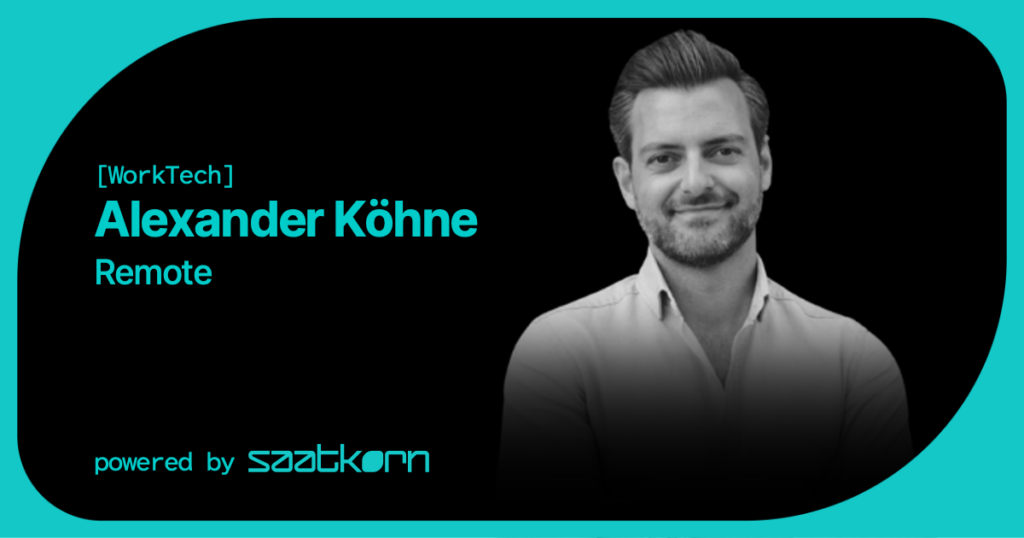
Talent is everywhere—but the opportunity to get hired isn’t: An interview with Alexander from Remote
The perfect candidate is in Spain. Or Portugal. Maybe India. But the company is based in Germany. So what then? Labor law, payroll, benefits, taxes, local regulations, possibly setting up a separate company—and “We’ll just hire internationally” quickly turns into a major project.
Alexander Köhne works at Remote and knows both sides of the story. Before he joined Remote himself, his former employer was already a client of the company, which enabled him to make the move abroad. Today, Alexander lives in Barcelona and spends his workdays addressing precisely the question of how companies can hire international talent without having to build their own infrastructure in every country.
In this interview, we discuss why global recruiting means more than just posting a job ad internationally, what an Employer of Record actually does, and how companies can even begin to expand their talent pool across national borders.
Let’s get started:
SAATKORN: Alexander, please introduce yourself briefly to SAATKORN readers. You’re the best example of working internationally yourself, aren’t you?
Absolutely. I currently live in Barcelona and work at Remote. What’s interesting is that I was already familiar with Remote before I started working there. My former German employer was a Remote client, and that’s how I was able to move abroad myself. So I first experienced the process from a client’s perspective and later decided to join Remote.
For me personally, the desire to live abroad was a key factor. At the same time, this gave me firsthand experience of the opportunities that arise when companies aren’t limited exclusively to a local job market in their search for talent.
SAATKORN: At Remote, you say: “Talent is everywhere, but the opportunity to be hired isn’t.” What’s the idea behind that?
Companies are looking for the best talent, and at the same time, many people today want to work more flexibly and independently of location. But just because a suitable candidate is located somewhere in the world doesn’t mean a company can easily hire them there.
That’s exactly where the gap lies.
We want to create the infrastructure that enables companies to hire, pay, and manage employees worldwide in compliance with local laws.
SAATKORN: As a recruiter searching internationally, I’m immediately faced with a much larger talent pool. What’s the catch?
The greater reach is just the first step. As soon as I actually want to hire someone in another country, a whole host of additional questions arise. What labor laws apply there? What are the salary regulations and pay scales? What benefits are standard? How does payroll work? What local requirements do I need to consider?
Traditionally, this can mean that I have to set up my own company in the respective country or work with various local service providers. And it’s precisely this complexity that often prevents companies from even trying international recruiting.
SAATKORN: You solve this with what’s called an “Employer of Record.” What exactly is that?
An Employer of Record, or EOR for short, enables a company to hire people in a country without necessarily having to set up its own company there. Remote has its own entities in numerous countries for this purpose and handles the administrative and legal infrastructure related to employment.
This includes, for example, employment contracts, payroll, and the respective local requirements.
The company itself continues to manage day-to-day operations and works with the employee as usual. It’s not temporary work, not freelancing, and not traditional outsourcing.
SAATKORN: So that means the employee is effectively working for my company, but is legally employed through your local entity?
Exactly. – We take on the corresponding administrative responsibility and ensure that the employment arrangement in the respective country is set up in compliance with the law. At the same time, the company retains control over day-to-day collaboration and the actual work. For employees, it should continue to feel as though they are working for their employer.
SAATKORN: Who would be interested in this? Only large companies looking to expand into new markets?
No, not at all. For example, I also work with smaller companies that might have 25 employees in Germany and would like to expand their talent pool. For such a company, it would be a significant undertaking to set up a branch office in a new country just for a single hire.
On the other hand, we also work with very large companies that are already active internationally and have many different local partners or structures. In some cases, the focus is less on expansion and more on consolidation—that is, reducing complexity and managing international employment through a more centralized infrastructure.
SAATKORN: Remote itself has nearly 2,000 employees in more than 90 countries and not a single office. At the same time, you receive over 34,000 applications per month. What do you do differently when it comes to recruiting?
For us, remote work isn’t just a buzzword—it’s part of our corporate structure and our identity. We work flexibly and asynchronously, hire globally, and have tailored our application process accordingly.
This means we don’t limit our talent pool to people who happen to live near an office or would be willing to relocate for a job. Of course, this places us at a particular end of the spectrum. But it shows what becomes fundamentally possible when geography is less of a constraint in recruiting.
SAATKORN: Does global recruiting automatically mean that every company should now hire worldwide?
No. Remote work—or international hiring—isn’t, of course, possible for every company and every role. There are jobs where people need to be on-site. But especially for roles that can, in principle, be performed from anywhere, it’s at least worth questioning your own geographical limitations. The question is: Does this person really need to be based in the same city or even the same country?—If the answer is no, a much larger talent pool suddenly opens up.
SAATKORN: At the same time, “hiring globally” sounds like quite a big change for an organization. How do you get started without turning everything upside down right away?
In practice, I often see two approaches: top-down or bottom-up.
Top-down means: Management decides that the company wants to become more international. Then the question arises as to what infrastructure and processes are needed for this.
Bottom-up can come from HR or recruiting, for example. There, they realize: We want to reach a larger talent pool and test whether international recruiting works for certain roles.
Then you can start with a pilot project and, for example, post one or two roles internationally. You don’t have to switch your entire recruiting strategy to a global one right away.
SAATKORN: What questions should HR ask itself before launching such a pilot project?
First of all: Who are we actually trying to reach? – Which roles are suitable? What target group are we looking for? And are we, as an organization, ready to work with people internationally or remotely? Because it’s not just about posting the job ad in another country. The internal strategy and infrastructure must also be aligned with this.
SAATKORN: What was your biggest “aha” moment for you personally when you yourself moved abroad to work remotely?
For me, the key realization was seeing that we could suddenly collaborate with people we simply wouldn’t have been able to reach before. At my employer at the time, for example, people were based in different countries, and HR was also distributed internationally. It was important for us to attract the best talent.
And that, for me, remains the core value to this day: Companies can hire people who are a good fit—both professionally and personally—even if those people don’t happen to live in the same place.
SAATKORN: International employment inevitably involves risk. What’s particularly important to you in this regard?
Compliance and transparency are key priorities for us. When companies employ people in other countries, it must be clear what is legally permissible, where risks lie, and what costs are involved. Our principle is therefore: Either we can implement something in full compliance, or we don’t do it at all. Equally important is transparency about what is possible and what isn’t.
SAATKORN: If you could share one thought on global recruiting with German HR and recruiting teams—what would it be?
Simply take a moment to question your own geographical limitations. Maybe you don’t have to recruit globally right away. But you can assess which roles are actually limited by the local talent pool—and which aren’t.
You can start small, test one or two roles, and learn from the experience. Talent is everywhere. The key question is whether we, as a company, can create the infrastructure to actually hire that talent.
SAATKORN: Alexander, thank you very much for the interview!