

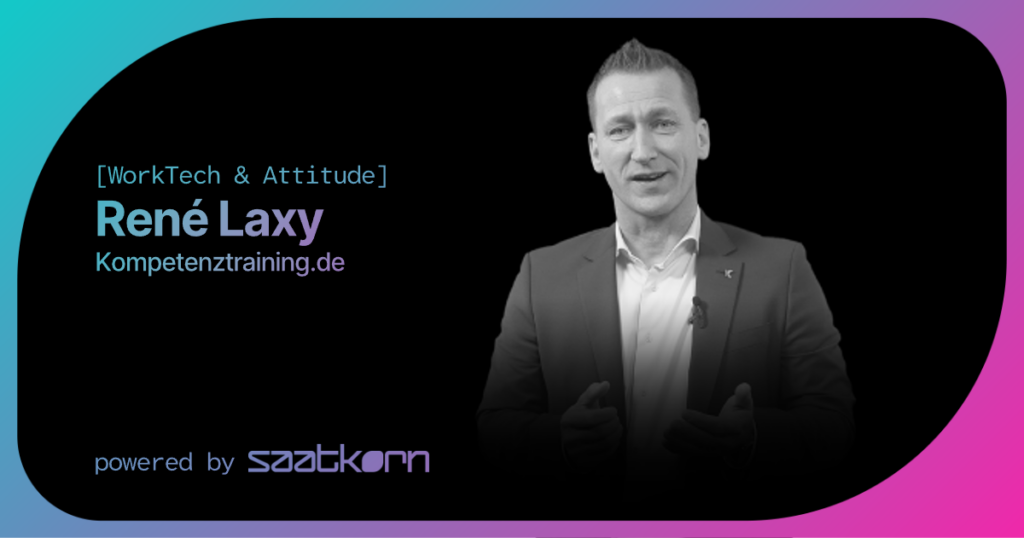
Many years ago, I trained as a systemic coach. I can wholeheartedly recommend it – even if you don’t work as a coach, the training is extremely helpful in understanding different perspectives. I was therefore all the more delighted to be able to speak to René Laxy about his approach and his book *The Systemic Performance Review*. Another topic we discussed was how AI can assist in this area. René is the founder and managing director of
Kompetenztraining.de. For over 23 years, he has been training and coaching managers in performance reviews, systemic questioning techniques, feedback and conflict management. He developed the WIRK feedback method and leads the seminar “Systemic Questions for Managers”. Let’s get started: SAATKORN: René, please introduce yourself briefly to SAATKORN readers.
I’d be delighted. I’m René Laxy, a trainer, systemic coach and founder of Kompetenztraining.de. Our focus is on seminars, coaching sessions, workshops and interactive e-learning courses. For over 23 years, I have been supporting managers in companies and public organisations in making leadership more effective in practice. For me, this is the best job in the world, because every day I get to empower people in their personal development.
My focus in leadership development lies where leadership actually takes place: in staff appraisals, feedback sessions, difficult conversations, conflicts and in the question of how leaders can encourage greater personal responsibility amongst their staff.
What never fails to inspire me in my workshops is the moment when, during a practical simulation, a manager tries out a systemic question for the first time and the person they’re talking to suddenly falls silent and starts to reflect. Shortly afterwards, they often say something like, ‘I’ve never looked at it that way before.’ You rarely achieve that with well-meaning advice.
SAATKORN: Your new book is called *The Systemic Performance Review*. What prompted you to write this book – and what, in your view, is fundamentally wrong with traditional performance reviews?
Systemic questions have fascinated me ever since I first came across them 14 years ago. Even back then, I thought: this powerful tool can be used not only in coaching, but also – in a slightly adapted form – for managers. In the years that followed, I delved deeper and deeper into systemic questions and increasingly integrated them into our leadership training programmes at Kompetenztraining.de. In doing so, I noticed time and again that many participants were not yet familiar with this approach. However, as soon as they tried out the questions on specific cases, they often had a genuine ‘aha’ moment. They realised that not only did this provide them with more information, but it also enabled them to trigger self-reflection, a change of perspective and the development of their own solutions amongst their staff.
I wouldn’t go so far as to say that something is fundamentally wrong with staff appraisals. I also find the distinction between ‘good’ and ‘bad’ communication too sweeping. In any given situation, there is rather a difference between more effective and less effective communication. It is not solely a question of how professionally we phrase something or with what intention we enter a conversation. What matters is the impact we have on the person we are speaking to. And in my experience of leadership practice, I often find that more could be achieved. In my book, I therefore address questions that we encounter time and again in our work with hundreds of managers:
How can performance reviews have a lasting impact? How can we give feedback that motivates rather than demotivates? How can tasks be delegated in such a way that they are truly understood and carried out? How do managers foster personal responsibility? How do they address performance issues without causing offence? How do they stay on topic when staff members digress? And how do they respond to a distorted self-perception?
In these situations, managers often tell their staff what needs to change. This can certainly be clear and necessary. However, lasting change rarely comes about through external advice – but rather through insights from within. By using systemic questions, we encourage self-reflection, open people’s eyes to other perspectives and empower employees to become the architects of their own solutions. This increases effectiveness, because people act on what they have realised for themselves – not on what they have been told.
This is precisely what inspired the idea for my book *The Systemic Performance Review: Questioning Techniques for Managers – Creating Clarity, Fostering Solutions and Achieving Impact*. In it, I use twelve types of systemic questions, numerous conversation patterns and more than 300 example questions to show how managers can make staff appraisals more effective.
SAATKORN: You say that leadership becomes more effective not through better answers, but through better questions. What exactly distinguishes a systemic staff appraisal from a traditional one?
A systemic staff appraisal is a conversation in which the manager uses targeted questions to ensure that employees recognise causes and effects for themselves and develop their own solutions. In a traditional appraisal, it is primarily the manager who thinks and speaks; in a systemic one, it is the employee.
The difference is best illustrated by a specific example:
An employee only informs her manager on the agreed deadline that she will not be able to complete a major task for a project on time. And this is now the second time this has happened.
Let’s assume the manager takes a traditional approach and uses the commonly employed WWW method for feedback: describe the observation, highlight the impact and formulate a request. It would sound something like this:
1. Describe the observation
: “Jana, I’ve noticed that, on the last two projects, you only informed me on the deadline itself that you wouldn’t be able to complete your task on time.”
2. Highlight the impact:
“This is problematic because it leaves me with hardly any time to react, and other colleagues also fall behind with their tasks as a result.””
3. Formulate a request
: “Please let me know straight away in future if you realise you might not be able to meet a deadline.”
Jana nods and promises to get in touch earlier next time. Three weeks later, she gets in touch again at far too short notice.
The manager conducted the conversation in a matter-of-fact, respectful and clear manner. However, for the most part, she was the only one speaking and thinking. Jana remained primarily a listener.
In a systemic staff appraisal, Jana would be actively involved in reflection and finding solutions. A possible sequence of events based on the WIRK method I have developed might look like this:
1. Describe your observation and ask about the context
: “Jana, in the last two projects, I only found out on the deadline day that you wouldn’t be able to complete your task on time. I’d be interested to know: what led to you not informing me sooner?”
Jana replies: “I thought I’d manage to sort it out somehow. Besides, you’ve always said that we should solve problems as independently as possible. That’s why I didn’t want to come to you straight away.”
2.Ask about the impact: “I see. What do you think the impact is on the others in the team – and on the project – when we only find out about a delay so late?”
Jana thinks for a moment: “Hmm… Isabella and Felix can’t carry on working with my results now and will probably have to catch up under time pressure. And the project is no longer on schedule. I’m sorry about that.
3. Agree on a solution
“It’s important to me that you continue to look for solutions independently. At the same time, we need to be informed of any potential delays at an early stage. How could we reconcile these two requirements?”
Jana suggests: “I could let you know as soon as I realise a deadline is at risk. It would be best if I also told you straight away what possible solutions I can see.”
4. Plan the next specific step
“That sounds good. What exactly will you do differently on the next project to ensure you identify and address potential delays at an early stage?”
Jana: “I’ll set myself interim targets for my tasks and check my progress regularly. As soon as things start to get tight, I’ll get in touch with you and, if possible, come up with a proposed solution straight away.”
I hope this example makes the difference clear. Whilst traditional feedback provides clarity, it does not automatically lead to a better understanding of the causes or to a lasting change in behaviour.
By asking systemic questions, we help employees recognise for themselves why and how they can make changes. The aim isn’t for them to know, after the conversation, what their manager would do. They should know what they themselves will do differently in future – and why.
SAATKORN: Many managers see their role as solving problems and providing answers. Why exactly can this be counterproductive?
First of all, I find this understanding of the role entirely understandable. Anyone who is appointed as a manager or sets up a business takes on responsibility for results. If problems stand in the way of these results, it is the manager’s job to clear them out of the way. And, of course, it’s good to come across as competent by providing a quick answer. After all, that confirms that you are rightly the manager.
However, responsibility for results does not mean having to solve every problem personally. Rather, a manager’s task is to ensure that problems are solved – whilst at the same time developing the team’s ability to take action and find solutions.
However, if a manager defines their role primarily as a problem-solver and answer-giver, they can easily fall into what is known as ‘overfunctioning’. In Murray Bowen’s family systems theory, this term is used to describe a reciprocal pattern: the more one person takes on, the less the other takes on. Instead of taking the pressure off the team, this behaviour weakens performance, personal responsibility and innovation in the long term. Three typical patterns emerge gradually:
Pattern 1:
The dependency trap. If, as a manager, you make the decisions, your staff get used to it. Why bother thinking for themselves then? As a result, even when faced with minor obstacles, they come to you for the ‘right’ answer. You become a bottleneck because every decision has to pass through your desk. You get bogged down in day-to-day business and lose sight of the essential leadership and strategic tasks.
Pattern 2:
Diffusion of responsibility. When you dictate the solution, it becomes your responsibility. And if something goes wrong? ‘I just did what you told me to.’ Your team members don’t feel responsible. Why should they? It wasn’t their idea, after all.
Pattern 3:
Missing out on better solutions. The best solution to complex problems rarely lies with a single person. If you dictate the answer, you nip specialist knowledge and creative approaches within the team in the bud. The best solution to a customer’s problem might well be held by the colleague who speaks to customers every day. Your solution, as a manager, may well be a good one. But is it really the best?
Of course, there are situations where a clear answer is required: when things need to be done quickly, or when only the manager has the necessary information. It’s not about never answering again, but about consciously choosing when an answer helps and when a question achieves more.
SAATKORN: Let’s get specific: an employee says during a conversation, “Yes, I’ll do it” – and then nothing happens. How would a manager with a systemic mindset proceed in this situation?
Ideally, they would have taken a different approach from the outset. Jana, from my example, reacted exactly like this after receiving standard feedback: she agreed and then repeated the same thing three weeks later. ‘Yes, I’ll do it’ is a polite phrase, not a commitment. Psychologists refer to this as the ‘intention-behaviour gap’ – the gap between wanting to do something and actually doing it. In 1997, Gollwitzer and Brandstätter demonstrated that people are significantly more likely to carry out their plans if they make concrete plans as to when and where they will act. That is why a leader with a systemic mindset would first check the understanding and the implementation plan:
- ‘What are you taking away from this conversation for yourself?’ Putting it into their own words immediately reveals whether both parties have understood the same thing.
- “What exactly are you going to do, and by when?”
- “What might prevent you from doing this, and how would you proceed in that case?”
- “What do you need from me to make this a success?”
To conclude, three points are clearly set out:
What specifically will be done? By when? How will both sides know that the agreement has been implemented?
In addition, a follow-up should be agreed. Without follow-up, even a good conversation often comes to nothing.
If the agreement is still not honoured, the feedback should be more firm. Here, it is important to clarify the reasons for the failure to implement it:
- Be specific: “What exactly prevented you from doing it?”
- Exceptions: “Were there times when it did work? What was different then?”
Depending on the answer, a distinction must be made:
- IF there is a problem with understanding, THEN clearly restate the expectation + put it in writing
- IF there is a lack of insight, THEN explain the ‘why’ again + clarify the consequences
- IF there are difficulties with implementation, THEN work out realistic steps together + follow up in 2 to 3 months
However, if agreements are repeatedly not adhered to despite clarified expectations, realistic conditions and the support offered, new questions are not always the answer. In such cases, the manager must clearly address the pattern, demand accountability and, if necessary, specify the consequences.
SAATKORN: What three systemic questions should every manager know to encourage greater personal responsibility and self-reflection among their staff?
Of course, there aren’t three ‘magic’ questions that work in every situation. If I had to limit myself to three particularly versatile questions, they would be these:
- The counter-question: “What do you think is the next sensible step?” It puts the ball back in the other person’s court when someone asks, “How should I go about this?”. The message behind it is: you are the expert on your own subject. Anyone who knows this question is coming will be better prepared in future.
- The circular question: “How would your colleague, your client or a neutral observer describe the situation?” It invites a change of perspective without being confrontational. Because the question is framed in terms of a third person, the pressure to justify oneself is reduced, and the realisation comes from the employee themselves.
- The scaling question with a follow-up: “On a scale of 0 to 10: where are you right now? And suppose you were one point higher: what would be different then?” A vague feeling is transformed into a tangible number. The follow-up question about the small next step comes from solution-focused therapy pioneer Steve de Shazer and prevents the conversation from ending up in a “It won’t work because …” rut.
However, their effectiveness depends heavily on the attitude behind them. Anyone who asks a question merely to skilfully steer the employee towards their own pre-determined answer is not really asking a systemic question. Good systemic questions require genuine interest in an answer, which may well turn out differently from what is expected.
SAATKORN: Managers often reach their limits, particularly when dealing with difficult topics such as performance issues, conflicts or a lack of motivation. How do systemic questions help in such situations – and where do their limitations lie?
In difficult conversations, systemic questions help above all to avoid jumping to conclusions about a supposedly clear-cut cause based on an observation.
Let’s take a drop in performance as an example. The quick diagnosis might be: ‘The employee is no longer motivated.’ However, this could be due to personal stress, unclear priorities, being overwhelmed, a lack of skills, a conflict within the team or conflicting expectations.
A manager who thinks systemically first describes specific observations, makes their expectations clear and then explores the interrelationships with a curious attitude. Instead of going into the conversation with a ready-made diagnosis such as ‘You’re unmotivated’, they might ask, for example:
- “If you compare your work today with the situation three months ago, what’s different?”
- “What is currently making your work more difficult for you?”
- “What do you need to be able to perform reliably well again?”
A systemic perspective is also worthwhile when dealing with conflicts. Instead of asking ‘Who is to blame?’, I ask ‘What underlying conditions are causing this conflict?’. Often, conflicting goals or unclear roles lie behind it. During the conversation itself, the question ‘What might your colleague’s good intention be?’ proves effective.
In cases of demotivation: “On a scale of 0 to 10: how motivated are you right now? And what’s keeping you at 4 rather than 2?” This question reveals the resources you still have.
Systemic questions are not, however, a panacea. In acute crises, in the event of safety risks, formal warnings or dismissals, clear decisions and unambiguous statements are required. In highly emotionally charged situations, the manager should first listen and be present on a human level before asking a series of questions. And managers are not therapists: where there are signs of burnout, the focus must be on the duty of care and professional help, for example via the company doctor. Furthermore, systemic discussions take time. They do not work when conducted in passing.
SAATKORN: In many companies, staff appraisals still take place once a year. Is this traditional format still appropriate today, or do we need a fundamentally different culture of dialogue?
I consider the annual appraisal to be very valuable. It creates a safe space to review performance, developments, goals and collaboration together. It becomes problematic, however, if it is the only serious conversation of the year.
No employee should find out for the first time during the annual review that their manager has been dissatisfied with their performance for the past six months. Nor should recognition, development requests or signs of burnout have to wait eleven months until the next official meeting.
I therefore believe a combination of different discussion formats makes sense:
-
- regular, brief one-to-ones – for example, weekly or fortnightly, depending on the role,
- prompt feedback on specific situations,
- agreed follow-ups after development or performance reviews,
- regular reviews of targets and priorities during the year,
- a more detailed annual review serving as a strategic look back and forward.
A good one-to-one is not merely a status meeting. Above all, it is time set aside for the employee: What is going well? Where are the obstacles? What is on their mind? Where do they need clarity, support or development?
The annual review may be an important milestone – but it should not be the only link between managers and employees.
SAATKORN: What role does HR play in this? How can HR departments support managers in establishing a systematic approach to dialogue in day-to-day management?
HR can help create the framework for an effective culture of dialogue.
This starts with a shared understanding of leadership: What do we expect from managers? How do we discuss performance? How do we encourage personal responsibility? How do we combine appreciation with clarity and consistency?
Subsequently, we need leadership development that goes beyond a one-off workshop on methods. Systemic communication is a skill that develops through trial and error, feedback and repetition. A seminar can provide the initial impetus – but what has been learnt is only applied with confidence in day-to-day management. I therefore consider programmes that enable participants to deepen their understanding and practise these skills to be very valuable.
In our leadership training programmes at Kompetenztraining.de, for example, we work with a personalised ‘situation-question’ matrix. Managers collect appropriate systemic questions for recurring situations such as delegation, feedback, conflict or resistance to change, and add to their experiences after the conversations: Which question worked well? How did the other person react? What would I phrase differently next time?
In this way, a personalised, practical toolkit is gradually built up.
SAATKORN: AI is currently opening up entirely new possibilities for managers – for instance, when preparing for feedback meetings or as a digital coaching tool. Where do you see opportunities and risks for the quality of staff appraisals?
AI can be a very good sparring partner. A manager can, for example, describe an anonymised appraisal situation and receive support in
-
- structure the flow of the discussion,
- develop appropriate systemic questions,
- run through possible reactions from the employee,
- critically examine their own perspective,
- prepare agreements and follow-up questions,
- to reflect on a conversation that has already taken place.
I find it particularly interesting not to ask AI for solutions straight away, but to let it ask follow-up questions first. A suitable prompt might be something like:
‘I’m preparing for a difficult staff appraisal. First, ask me three questions about my situation and the aim of the conversation before you make any suggestions.’
AI as a digital coaching tool – provided the tool is well designed – offers a great opportunity to practise staff appraisals in a safe environment.
In this way, the AI helps the manager to examine their assumptions, blind spots and their actual objective more closely.
At the same time, I see clear limitations. AI does not know the person. It does not pick up on a hesitant glance, a change in tone of voice or tense body language. Nor does it ever know the full organisational and personal context. Its suggestions may be inappropriate, stereotypical or factually incorrect.
Added to this is data protection: personal, confidential or health-related information has no place in public AI systems or those not authorised by the company. Cases should be consistently anonymised, and companies need clear rules governing permitted applications.
My guiding principle is therefore:
AI as a thinking partner – not as a decision-maker.
AI may be used to prepare for a staff appraisal. However, it must neither diagnose the individual nor make the managerial decision. Whether a question is helpful at the right moment, whether it is better to ask for clarification or remain silent at that point, and which decision is justifiable, remains the responsibility of the manager.
SAATKORN: If a manager wants to start conducting their staff appraisals in a more systemic way tomorrow, what three specific tips would you give them to get them started?
Apart from a good book on systemic questions with practical exercises, I recommend attending a seminar on ‘Systemic Questions for Managers’ to apply these principles directly in management practice.
To practise systemic questions until they become second nature, here are three tips:
- Systemic questions are merely a tool. The manager’s attitude provides the framework that makes them effective. It therefore makes sense to start by reflecting on your own (systemic) attitude as a manager. This in itself automatically has a huge impact.
- Most staff appraisals are scheduled in advance. It is perfectly acceptable to jot down 2–3 systemic questions and appropriate follow-up questions on a card before an important meeting.
- To use systemic questions confidently in practice, it is not enough simply to know them in theory. You must be able to recall them at the right moment – without having to think too long. To this end, it is advisable to create a ‘situation–question’ matrix with a personal collection of questions, organised according to typical leadership situations.
SAATKORN: Finally: What do you hope readers will actually do differently in their day-to-day leadership roles after reading your book?
I hope that, after reading my book, readers will develop a new reflex. Before giving a ready-made answer, they’ll pause for a moment and ask themselves:
Does the person I’m talking to actually need my solution right now – or a question that will lead them to their own solution?
Perhaps the next time they’re faced with ‘What should I do now?’, they’ll pause briefly and, instead of answering, ask: ‘What do you think is the next sensible step?’
Perhaps, when a conflict arises, they’ll no longer immediately ask, ‘Who started it?’, but instead: ‘What underlying factors are contributing to this conflict recurring time and again?’
Perhaps, when faced with a problem, they won’t straight away tell the other person what to do, but will ask: ‘What have you already tried, and which of those things worked at least a little?’
Perhaps, at the end of a conversation, they will no longer accept a non-committal ‘Yes, I’ll do it’, but will instead work together to agree on a specific next step.
And perhaps they will listen a little longer before they judge, explain or decide.
If, after reading this, managers are able to choose more consciously between explaining, deciding, listening and asking questions, the book will have achieved its aim. After all, systemic leadership does not mean always asking questions. It means deciding more consciously, in each specific situation, which form of communication will have the greatest impact.
A good question can transform a conversation. Many transformed conversations can change an entire leadership culture.
SAATKORN: René, thank you very much for these brilliant insights into the systemic staff appraisal! We wish you continued enjoyment and success!
Further links
René Laxy on LinkedIn
Visit the Kompetenztraining website
Information on the seminar: Systemic Questions for Managers
Find out more about the book HERE