

Automation Platform for HR
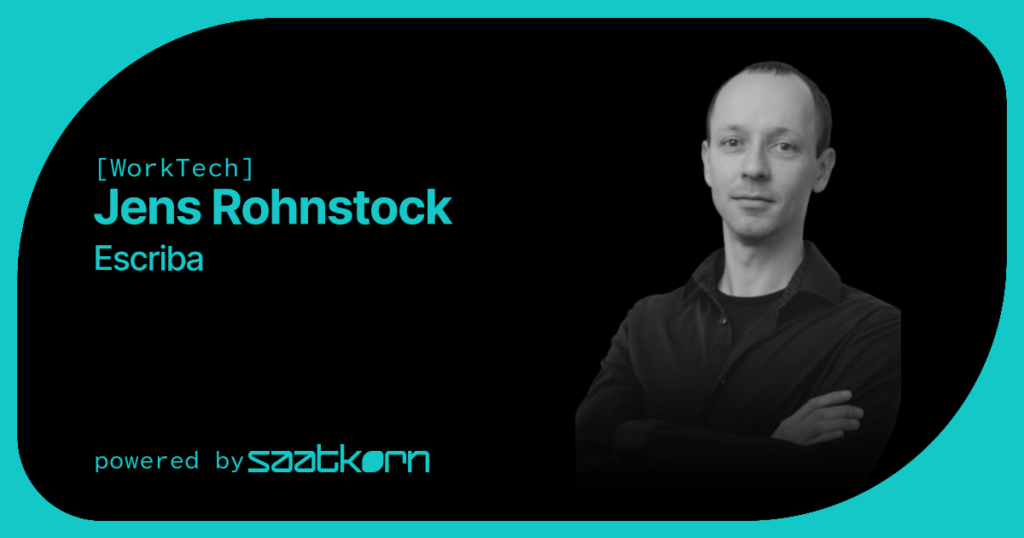
With the Enterprise Agent Network (EAN), ESCRIBA has now built its own automation platform for HR. Similar automation platforms, such as n8n or Make.com, have long been familiar to tech-savvy users. I had the opportunity to speak with ESCRIBA CTO Jens Rohnstock about this: how EAN works, how it differs from traditional no-code tools, and how much technical knowledge users need to get started.
How Scenarios and Connectors Work
SAATKORN: What inspired you to build your own automation platform for HR?
ESCRIBA’s value proposition is to comprehensively support companies in the automation and digitization of HR processes. The greatest untapped potential lies in HR administration. That’s exactly where our strength lies. We provide and continue to develop a digital platform for HR that offers various functions and capabilities for this purpose. AI has been part of the picture for years now. With our no-code/low-code/AI platform, we were already among Europe’s technology leaders. EAN was a logical next step: At ESCRIBA, we always tell a story of digitization and AI for HR—from personnel files and document creation to AI-supported process automation. Depending on a customer’s needs, the building blocks of our platform must be interwoven. EAN was created precisely for this purpose: it’s the module that allows us to flexibly connect these building blocks and automate processes end-to-end.
SAATKORN: How does an automation platform like this generally work?
You build workflows—which we call “scenarios”—from nodes that are graphically connected to one another. A trigger starts the process; then data is processed, analyzed via AI nodes, and finally stored or written back to another system. AI is just one component in these scenarios; data is pulled from various systems, processed, and stored there again. No programming knowledge is required for this; processes and the functions of individual nodes are specified in natural language. Data connections, or “connectors,” are crucial to the usefulness of such platforms.
SAATKORN: What exactly are these “connectors”?
These are interfaces through which data is retrieved or passed on. Ultimately, a workflow accomplishes something that in the past would not have been incorrectly referred to as “software” or a “software extension”—it can be quite simple or quite complex. Unlike with traditional software solutions, however, users are independent in this process because they do not need in-depth programming knowledge and can customize and expand digital processes with minimal effort.
HR Integration and Practical Application
SAATKORN: What makes EAN special, for example, compared to the general-purpose provider n8n?
n8n has a huge community and many connectors, such as those for WhatsApp or Signal. Most of them aren’t particularly relevant for HR. Instead, we have fewer but more specialized connectors that are precisely tailored to the HR environment. Our integrations extend to the digital personnel file, our ticketing system, and—via the ESCRIBA Integration Server—to SAP, SuccessFactors, Workday, or Salesforce. This allows us to connect the automations created with EAN to the most widely used HCM systems. Additionally, EAN is connected to large language models such as ChatGPT or Claude via the Machine Context Protocol (MCP). You simply say in the chat, “Create an employment contract for Max Mustermann,” and EAN handles it in the background. You no longer have to connect the nodes manually: you describe the desired scenario to the AI in plain language, and it builds the graph itself.
SAATKORN: Please describe in detail a use case where EAN solves a problem for one of your customers.
One of our clients wanted to give employees access to their own personnel files but had inherited legacy files where it wasn’t clear whether all documents had been correctly assigned. This posed data protection risks. The goal was to prevent people without sufficient user rights from accessing sensitive data. Now, an EAN scenario runs automatically for every access request: Using a workflow built into EAN, the content of all documents belonging to the individual is reviewed by AI. The system verifies whether the document type matches the intended recipient and flags only unclear or incorrectly assigned cases. These are then forwarded to a case handler. If the situation is clear, access is automatically granted. Without the EAN solution, the client previously had to manually review hundreds of files in such cases before approval.
Technical Requirements for HR Professionals
SAATKORN: Can “ordinary HR professionals” with an interest in technology actually use the tool to build digital/AI processes themselves? How deeply do they need to dive into the technical details?
In principle, that’s correct: Our customers don’t need in-depth programming knowledge for EAN; the code is written by describing the initial data situation, the function, and the desired result in natural language. However, we find time and again that—precisely because HR involves handling personal data—managers need the ability to think of a problem in terms of data structures and process logic. Unless you have a background in computer science or business informatics, you’ll need to learn this first. For our new AI approach, this currently involves mainly learning by doing: We support customers through project teams that build scenarios collaboratively, serving not only a programming purpose but also a training one. There are also additional courses available for classic building blocks.
SAATKORN: Thank you, Jens, for these fascinating insights into HR automation with EAN.
Further links:
Escriba Website
Jens Rohnstock on LinkedIn