

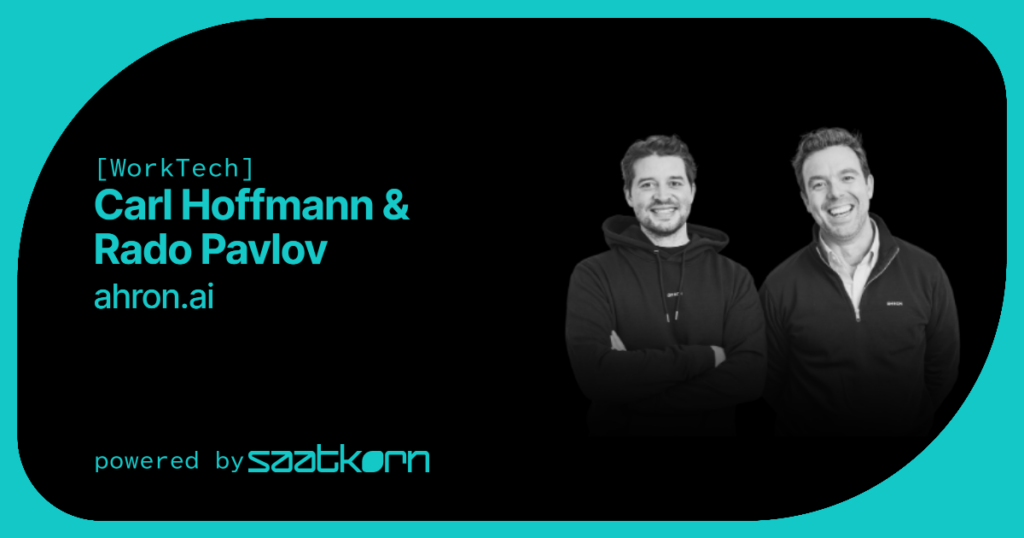
Carl Hoffmann is launching a new startup: ahron.ai. Together with his COO, Rado Pavlov, he’s building the “Operating System for AI Agents in HR”—as stated on the ahron.ai website. That sounds exciting, so I decided to ask Carl a few more questions. Let’s get started:
SAATKORN: Carl, you’ve been a guest on the SAATKORN Startup Talk before. A lot has happened at Ahron since then. First of all, congratulations on the €2.2 million funding round! If you had to summarize the developments since our last conversation in three points: What turned out differently than expected—and what developed faster than anticipated?
Carl: Looking back on the last few months, three things stand out to me.
First: Context has become even more important than we thought. We started out assuming that the biggest leverage lay in the agents themselves. In practice, our customers quickly realized that an AI agent is only as good as what it knows about the company. They need clean data, have to break down data silos between their HR systems, and define clear policies. A new colleague brings common sense to the table and asks questions when something seems off. An AI agent doesn’t do that. “Common sense” simply doesn’t work with agents. That’s why we don’t believe in “out-of-the-box” AI agents.
Second: the team. From my time at Talentry, I know how long it can take to find the right people. This time, it went much faster. In a short time, we’ve put together a team that my co-founder Rado and I are truly proud of—one made up of people who understand HR, processes, and AI in equal measure.
Third: international demand. We had actually planned to focus clearly on the DACH region. But through our partnership with Celonis, we’re receiving inquiries from all over the world, and we can meet this global demand without having to be on-site everywhere ourselves. A year ago, I wouldn’t have thought we’d be acquiring customers in the U.S. this early.
2.2 Million Euros for AI Agents in Recruiting and Payroll
SAATKORN: You’ve now raised €2.2 million from Cusp Capital, superangels, and well-known business angels. Why was now the right time to raise external capital—and why do you need it given your already strong growth?
Carl: To be honest, the market kind of made the decision for us to some extent. We built our first AI agents for talent acquisition—specifically for screening, scheduling interviews, and gathering feedback from hiring managers. There, we proved that it works. But in almost every client meeting, the question eventually came up: “Can you do this for our HR services, too? And for payroll?” There’s enormous potential lying dormant there.
That’s exactly why we need the capital now. We want to build specialized teams around individual use cases—teams that know their processes inside and out. Payroll is a completely different world from recruiting, with its own rules, its own risks, and its own language. Our goal is to support HR end-to-end with AI agents, from hiring to departure. So that HR teams can once again spend their time where they truly add value.
And with Cusp Capital and our angel investors, we have people on board who know HR and enterprise software from personal experience. That was just as important to me as the money.
SAATKORN: According to the press release, you’ve already generated more than €1 million in ARR since the start of the year and acquired customers in Europe and the U.S. What’s behind this rapid growth—and what specific problems are your customers currently bringing to you?
Carl: Our customers don’t come to us because they want to do “something with AI.” That phase is over. Many companies have launched AI pilots over the past two years and now need to answer what those pilots actually achieved. They finally want to prove the ROI of their AI initiatives.
The questions they bring to us are correspondingly specific. How can I use AI agents to reduce my time-to-hire by 30 percent? Where in my HR processes is the most administrative work? How can I make my payroll less prone to errors?
We always follow the same approach. First, we create a digital twin of the process—that is, a representation of how it actually unfolds in reality, rather than how it’s described in the process manual. Then we outline the solution and quantify the potential in euros and in days. Only then do we deploy AI agents—precisely where they’ll have the greatest impact. This addresses a very specific problem. I believe that’s exactly what explains our growth.
How ahron.ai Automates HR Processes with AI Agents
SAATKORN: The HR tech market is currently being flooded with new AI agents. You deliberately position Ahron not as just another standalone tool, but as an overarching layer on top of the existing HR system landscape. How do you explain to a CHRO in two minutes why this additional layer is necessary?
Carl: I don’t need two minutes for that.
Most large, global companies have over a hundred HR systems in use. I don’t believe it’s possible to consolidate them all into a single system—many have already tried that. Nor do I believe a CHRO needs yet another HR system. So we integrate into the existing landscape and provide what’s been missing so far: visibility and control over the entire process. Thanks to process mining technology, I can track every single activity of an AI agent. We call this “agent mining.”
And if there’s time left, I tell the CHRO: You’re not getting new software that your people have to learn. You’re having work taken off your hands.
SAATKORN: “Agentic AI” sounds impressive—but what really matters is what actually works in day-to-day HR. Which HR processes are your agents already handling largely autonomously today? And where does the technology still have limitations?
Carl: I’ll start with something that’s important to me: People want to talk to people. A job applicant wants to speak with a human at the decisive moment, not a bot. So does an employee with a difficult question about their parental leave.
The problem is that many HR teams barely have time for these very conversations anymore. Their days are consumed by tasks that nobody really wants to do: manually screening resumes, rescheduling interviews for the third time, reconciling fields across systems, filling out spreadsheets, and amending contracts.
We’re already automating these very workflows to a large extent. The AI agent takes care of the tedious work, but humans remain in the loop. To do this, we integrate with messaging platforms like Teams or Slack—the very places where people work anyway. The agent prepares, suggests, and reminds. The human makes the decision.
The technology always reaches its limits where context is missing—that is, where rules aren’t clear or data is contradictory. And wherever judgment, empathy, and responsibility are involved, humans should remain in control. To me, this has less to do with technology than with mindset.
Celonis and Process Intelligence as the Foundation for Controllable AI Agents
SAATKORN: Your partnership with Celonis and the idea of a digital map of HR processes play a central role. How does this work in practice—and why do you believe Process Intelligence is a prerequisite for AI agents to not only complete individual tasks but also orchestrate entire HR processes?
Carl: I’d like to explain this with an analogy. Imagine you’re starting at a new company and are tasked with improving the hiring process. You ask five colleagues how it works and get five different answers. That’s exactly how an AI agent operates today.
With Celonis, we’re changing that. Every HR system leaves a digital trail: When was the job posted? When did the application come in? When did the manager provide feedback? When was the contract sent out? We piece together these trails from all systems to create a digital twin of the process. Suddenly, you can see how things really work—where applications sit unprocessed for days, where data is manually transferred three times, and where most errors occur.
This twin gives us two things. We see exactly where an AI agent has the greatest impact. And we give the agent the context they need to do their job. They know their task and, at the same time, understand what happened before and what needs to happen next.
An agent without this overview is like a very hardworking intern who completes a task perfectly but doesn’t know what it’s for. Only by looking at the entire process can it orchestrate rather than just work through tasks.
SAATKORN: Especially in the HR environment, AI agents work with highly sensitive data and make—or support—potentially far-reaching decisions. How do you ensure that companies can always understand and control what an agent is doing, why it’s doing it, and what rules apply to it?
Carl: For me, this has three levels.
The first is the data. Our agents can work with pseudonymized data. Take the verification of pay supplements before the payroll run: The agent checks whether a night shift supplement complies with the collective bargaining agreement, whether the recorded hours are complete, and whether the amount is plausible. To do this, it doesn’t need to know that the hours belong to Maria Müller from Logistics. It only sees “Employee 48213.” Only when a human reviews a suspicious case does the customer’s system reveal who is involved. The agent themselves does not handle any personal data.
The second level is context and control. We developed Ahron Nexus for this purpose. Put simply, it’s the set of rules that every agent must follow. A language model is creative by nature, and creativity is pretty much the last thing you want in payroll. Nexus ensures that the agent executes deterministic instructions. For example: If a contract amendment includes a pay raise, it requires approval before it enters the system—without exception and with no room for interpretation. These rules are managed centrally, and the HR team can view and adjust them at any time.
The third level is traceability. Through agent mining, every action an agent takes is documented: what it did, when, on what basis, and according to which rule. If the works council or the audit department asks, there’s an answer. We don’t have a black box.
How Agentic AI Is Changing HR Software and HR Work
SAATKORN: Many companies have built up extensive HR tech landscapes over the years. Will we need less HR software in the future thanks to Agentic AI—or will the main change be in how these systems are connected and used?
Carl: I expect that the core systems will remain in the enterprise environment—namely, Workday, SuccessFactors, UKG, ServiceNow, and the like. That’s where the master data resides; that’s where the truth about employees, contracts, and organizations lies. That won’t change anytime soon.
Everything around them, however, will change. Today, a company buys a separate tool for many individual problems: one for scheduling interviews, one for references, one for onboarding checklists. Many of these standalone solutions will no longer be needed in the future because it has become much easier to develop an AI agent specifically for that purpose.
And here’s the point that many underestimate: The easier it becomes to build agents, the more important context becomes. A hundred agents without a shared understanding of processes, data, and rules spell chaos. What matters most, therefore, isn’t so much how much software a company has, but whether everything is built on a common foundation.
SAATKORN: Ultimately, your promise is this: less administration, more time for leadership, development, and culture. But technology alone doesn’t transform an HR organization. In your view, what mindset does HR need so that this technological opportunity actually leads to a different kind of HR work?
Carl: Change starts at the top. If the executive board views AI primarily as a cost-cutting measure, HR won’t get much more out of it either.
What’s needed now are true innovators—people who are eager to redesign the future of work. People who ask questions that didn’t even exist three years ago: What does a team look like where humans and AI agents work together? Who bears responsibility when an agent makes a mistake? What does good governance look like for both?
I find this absolutely fascinating. I’ve been active in the HR tech market since 2012, and I’ve never experienced a moment when HR had as much influence on how a company will operate in the future. I really hope that HR leaders are given the creative freedom needed to make this happen—and that they take it for themselves if it isn’t given to them automatically.
SAATKORN: The new capital is intended to go primarily toward product development and international expansion. Where do you see Ahron in two years—and how would you personally measure whether the next phase was successful?
Carl: Our goal—and I’m not just saying this for the sake of it—is to have nothing but happy customers. Customers who derive genuine, quantifiable value from our platform and can back that up with numbers.
If, in two years, we have 100 international customers who are 100 percent satisfied, that would be fantastic. Along the way, we want to cover HR end-to-end—from recruiting to HR services to payroll—and significantly expand our presence in the U.S.
Revenue and growth are ultimately a result of that. If our customers recommend Ahron without us even asking them to, then I know we’ve done it right.
SAATKORN: Carl, thank you very much for the interview, and we wish you continued success!