

From 26 to 30 August, Cologne will once again become the world’s biggest gaming stage. For HR departments, gamescom has long been more than just a bit of fun: in a dedicated hall, the German Armed Forces, banks and public authorities compete side by side to attract young talent. Guest author Alexander Albrecht from Build a Rocket explains what makes a gamescom presence a recruitment success – and where companies waste their budget:
Anyone looking for apprentices, trainees or skilled workers these days will get very little out of a job advert on a careers website. Younger target groups, in particular, often no longer even notice traditional job portals. This hits sectors and professions particularly hard where there is already a desperate need for new talent – anyone wanting to stand out there must offer significantly more than a well-written advert.
This is precisely where gaming – and, above all, gamescom – comes into play. In 2025, gamescom attracted 357,000 guests, with 41 per cent of private visitors aged between 16 and 25. The trade fair has long since ceased to be merely an entertainment event for gaming fans. In recent years, more and more companies have realised that they can reach their target audience there in a more concentrated way than almost anywhere else. Accordingly, there is a dedicated recruitment area known as the ‘gamescom jobs & career area’, organised by heise jobs. Among those confirmed for this year are Airbus, the German Armed Forces, the Deutsche Bundesbank, the Federal Intelligence Service, Siemens, Rheinmetall, DATEV, as well as several state police forces and ministries. However, to be successful at the world’s largest gaming trade fair, more is needed than just a presence.
Winning over visitors through gameplay rather than handing out leaflets
For its 2025 gamescom appearance, Commerzbank had its platform game ‘Riskscape’ programmed entirely by its own trainees and made it available to try out directly at the stand. An additional claw machine was used over 3,000 times during the five days of the fair, and the bank’s careers page recorded more than 750 additional visits. The consultancy firm Ecovis also relied on a game it had developed in-house in 2025: “Reclaim the Chain”. In this cooperative two-player format, visitors must work together to fend off a fictional cyberattack on the blockchain. Both examples follow the same principle: they translate real-world professional content – such as software development and IT security – into a game concept, rather than simply plastering a logo onto a screen.
Consistency beats a flash in the pan
Whilst a gamescom appearance can generate attention in the short term, it does not, on its own, build an employer brand. The companies that actually benefit from the skills shortage in the gaming sector treat esports and gaming as an integral part of their HR strategy, rather than as a one-off trade fair appearance in August. This applies both to the integration of various channels within a campaign and to partnerships that develop over the years.
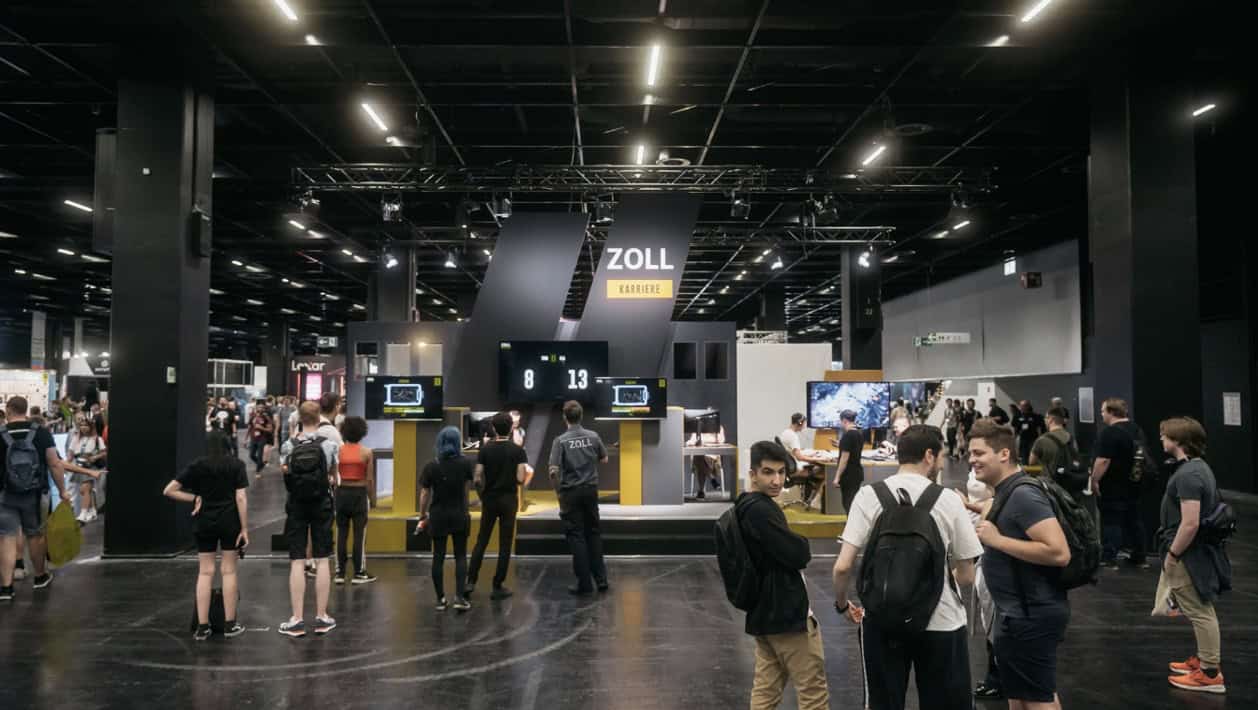
German Customs, in collaboration with Build a Rocket, developed a stand that deliberately played on its own job profile: it resembled an X-ray scanner. The whole experience was gamified, and visitors could have objects X-rayed. A gaming area and a lounge invited visitors to find out about career opportunities with Customs.
This principle also works in the other case studies: the stand translates an actual job function – customs checks – into a playful, easily understandable activity, rather than simply handing out leaflets. The presentation was complemented by online game shows in which high-reach content creators, together with real customs officers, explained the training pathways within the agency. In this way, the reach of the content creator collaboration was combined with direct, personal contact at the stand.
SAP is also active at gamescom and has been involved in esports since 2018, including as a data analytics partner for Team Liquid. For the software group, this is more than just brand building, as the tech industry needs digital natives and highly qualified specialists. It is precisely this target group from the gaming community that brings skills such as coordination, strategy and teamwork to the table – skills that are also in demand in day-to-day working life at SAP. This commitment is also evident at gamescom itself: together with Build a Rocket, SAP presented its analytics programme, developed specifically for esports. This was documented in the multi-part film series ‘A New Perspective’ – proof that a single trade fair appearance has evolved into a long-standing partnership over the years.
The real work begins after the trade fair
An employer brand cannot be built during the five days of the trade fair in Cologne. Anyone who turns up in August and then disappears for a year was never really present for the target audience. Ecovis has therefore deliberately designed its game so that it can be reused at other events with minimal effort. Other companies are committed to a long-term presence in the gaming sector. It is precisely these approaches that distinguish a well-thought-out investment from an expensive flash in the pan.
For HR departments, this means that gamescom is not a sure-fire success and is no substitute for a functioning recruitment strategy. It is a place where it becomes clear who has truly understood the target audience. Anyone attending for the first time in 2026 should worry less about the size of their stand and more about the story they want to tell there. And whether that story will still hold up come September.
About Alexander Albrecht
Alexander Albrecht is the managing director of the gaming agency BUILD A ROCKET and has held senior positions within esports for over 20 years. He is one of Europe’s leading industry experts and, together with his team, works with clients including SAP, KitKat, Ralph Lauren and Uber Eats.
Further links
Alexander Albrecht on LinkedIn
Build a Rocket website