
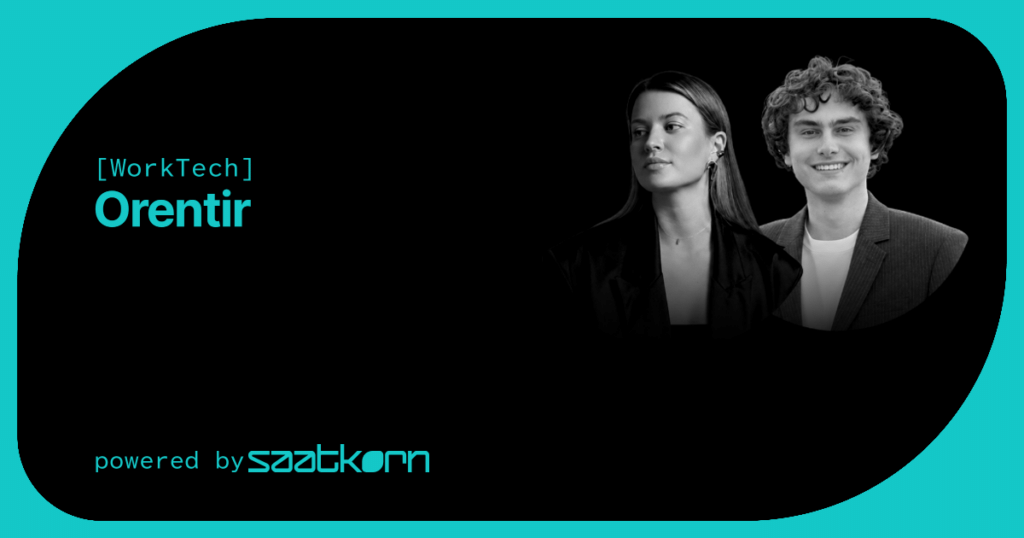
As part of the SAATKORN HR Start-up Series, I’d like to introduce you to Orentir today. This Swiss company identifies organisational risks before they materialise – fascinating! I had the opportunity to speak to co-founder Anastasia Lesovaya (pictured here with co-founder Anatoly Grebenyuk). Let’s get started:
SAATKORN: Anastasia, please introduce Orentir to SAATKORN readers!
We are Orentir, a Swiss WorkTech start-up that develops role-based risk analyses for companies. We model which roles a company is critically dependent on, what happens when a role becomes vacant or changes, and how these dependencies shift during growth, restructuring, mergers and acquisitions, or as a result of AI.
Our founders know the problem first-hand. Anatoly Grebenyuk has developed HR analytical models and worked in corporate HR research; Anastasia Lesovaya has spent the last few years working in the commercial and operational divisions of an HR firm, where she led the growth, client services and profit and loss departments. The team is also supported by a senior consultant who has extensive corporate experience in organisational transformation, succession planning, leadership and the implementation of GenAI in the Swiss financial services sector, as well as at the ‘Big Four’ consultancy firms.
We are based in Switzerland, form part of the InnoJura ecosystem and have been accepted into the Innosuisse Business Concept Programme. And yes, we have a working MVP – not just a very nice pitch deck!
SAATKORN: What’s the story behind the founding of your HR start-up?
It began with a very simple question that turned out to be surprisingly difficult to answer: What actually happens to the company if a key position becomes vacant tomorrow?
Anatoly first recognised this gap whilst working in HR research for large corporations. Although large organisations had HR data, succession plans and dashboards, as soon as the discussion shifted from ‘Is this role filled?’ to ‘What happens if this role remains unfilled for three or six months – which processes and decisions are affected, and how long does it take to restore operational readiness?’, the answers became significantly less precise. An Excel file often came into play. Usually, several meetings were held as well.
That is why we did not start coding straight away. First, we conducted over 30 structured interviews with CHROs and HR leaders from seven sectors and six countries. The same pattern emerged time and again: whilst companies had ample HR data at their disposal, decisions regarding the criticality of roles, organisational dependencies, succession planning, readiness gaps, scenario impacts and business risks were often still being made on a qualitative and manual basis.
Orentir was developed to address this missing link between organisational design, workforce planning and business risk. We are currently testing this approach via four market entry channels: enterprises, private equity, consultancy and scale-ups.
SAATKORN: What is your mission – what problem are you aiming to solve?
Our mission is to make organisational risks visible before they turn into an incident within the organisation.
One principle is central to Orentir: we analyse roles and organisational dependencies. Criticality is not the same as hierarchical level: a role may be situated far below senior management yet still represent a single point of failure due to scarce specialist knowledge, decision-making powers, process dependencies or business implications.
Orentir identifies critical roles, succession gaps and dependencies between individual roles; quantifies the associated operational and financial risks; and models scenarios such as vacancies, restructuring, growth or organisational redesigns. We also develop an AI impact layer that examines roles at the task and functional levels – asking not simply, ‘Can AI automate this job?’, but rather, ‘If AI changes this role, which skills and dependencies will become more important as a result?’
We don’t simply want to provide HR with yet another dashboard. We want to give senior management a way to test organisational decisions before they are implemented across the organisation.
SAATKORN: What does the business model of your HR start-up look like?
At its core, it is a B2B software platform with business models tailored to four segments. The product is one and the same; the path to added value differs depending on the market.
For the corporate sector, we’re starting with a targeted pilot project centred on a real organisational decision and aim to convert successful use cases into recurring SaaS revenue. For the private equity sector, the use case involves assessing organisational risks across portfolio companies, conducting due diligence and developing value creation scenarios. For the consultancy division, Orentir can become an analytical framework used across all client projects, rather than merely serving as a one-off diagnosis. For scale-ups, the focus is on organisational resilience and investment readiness ahead of rapid growth or a funding round.
Across all four segments, the core remains the same: the criticality of roles, interdependencies, succession risks, financial implications, scenario modelling and AI-driven changes are transformed into a repeatable decision-making system. We are not developing four products – we are testing four ways in which the same intelligence creates value.
SAATKORN: How would you describe your ideal customer profile?
We are testing four customer segments, as the same problem of organisational risks manifests itself in different forms.
Large enterprises: large, complex organisations (typically 1,000+ employees) where role continuity, succession, restructuring and organisational redesign are already business-critical.
Private equity: operational partners and portfolio teams who need to identify where organisational dependencies could impair value creation, implementation or leadership continuity.
Consulting: teams specialising in organisational design, workforce restructuring and HR consultancy, who require a structured, repeatable analytical framework for their client work.
Scale-ups: founders and management teams facing rapid growth or a funding round, who need to understand whether the organisation is robust enough for the next phase.
Buyers vary depending on the segment – ranging from CHROs, heads of workforce planning and CFOs to operational private equity teams, consultants and scale-up founders. The common thread is the same: if a role or an organisational change can significantly impact business performance, it should be modelled rather than merely discussed in qualitative terms.
SAATKORN: In which countries do you offer your products or services?
We are currently in the MVP and pilot validation phase, with Switzerland as our home market and the DACH region representing our first commercial focus across all four segments.
HR and business leaders from six European countries have already taken part in our Discovery programme, meaning the product was designed with an international context in mind from the outset. Following the DACH region, we plan to expand into the Benelux countries and the Nordic countries, followed by the wider EU market.
In other words: Swiss roots, European ambitions and absolutely no intention of staying small.
SAATKORN: What is your vision – where do you want to be in three years’ time?
In three years’ time, Orentir aims to be the ‘Decision Intelligence’ platform people turn to when an HR or organisational decision is too important for a spreadsheet and too dynamic for an annual review.
This means that companies will use Orentir to model the continuity of critical roles, succession planning, restructuring and AI-driven workforce redesign; that investors will use it to understand the organisational risk of their portfolio companies; and that consultants use it to make organisational analyses more structured and repeatable. Orentir is designed to integrate with existing HR and business data, rather than replace it, and to remain useful even during organisational changes.
From a business perspective, the aim is to build a significant customer base in the DACH region and the Benelux countries, demonstrate repeatable use cases in large enterprises and scale-ups, and expand sales through partnerships with private equity firms and consultancy firms.
The overarching vision is simple: there are models for financial risks, there are models for operational risks, and there are models for cyber risks. There should also be models for organisational dependency risks.
SAATKORN: If you had three wishes, what would they be?
- That every succession plan came with a ‘what-if?’ button. A succession plan on paper is useful; knowing what will happen in the months before that plan can be implemented is better.
- That discussions about AI and the workforce go beyond the question ‘How many staff can we cut?’ and also ask: ‘What new dependencies are we creating?’ AI can reduce the workload in a role whilst simultaneously making the remaining responsibilities – relating to judgement, relationships or decision-making – even more important.
- That the risk of organisational dependencies is taken just as seriously at board level as financial, operational and cyber risks. As a side effect, we’d be happy to do without a few colourful spreadsheets.
SAATKORN: How and where can potential customers contact you?
The easiest way is via our website
.
You can also contact the founders directly via LinkedIn: Anastasia Lesovaya
or Anatoly Grebenyuk
. We’re currently in talks with enterprise teams, private equity teams, consultants and founders of scale-ups who are ready to put the MVP to the test using a real-world role or organisational scenario.
If there’s a role, a dependency or an organisational change that everyone knows is important, but which no one has yet been able to model properly, we should probably have a chat!
FACTS & FIGURES
- Year founded: 2026
- Number of employees: 2 founders (+ Senior Advisor)
- Headquarters: Courroux, Switzerland (Switzerland Innovation Park)
- Funding round: Pre-seed
Are YOU a start-up founder too?
And would you like your company to be featured for free in the SAATKORN HR Start-up Series? – Then answer THESE QUESTIONS, include some good photos and – if available – a video link, and send it all to hrstartups@saatkorn.com – Important: please do not change the formatting of the questions and return everything as a .doc file – THANK YOU. Your feature will then appear here on the blog, in my newsletter, and you’ll get a free social media boost on top. DEAL?