

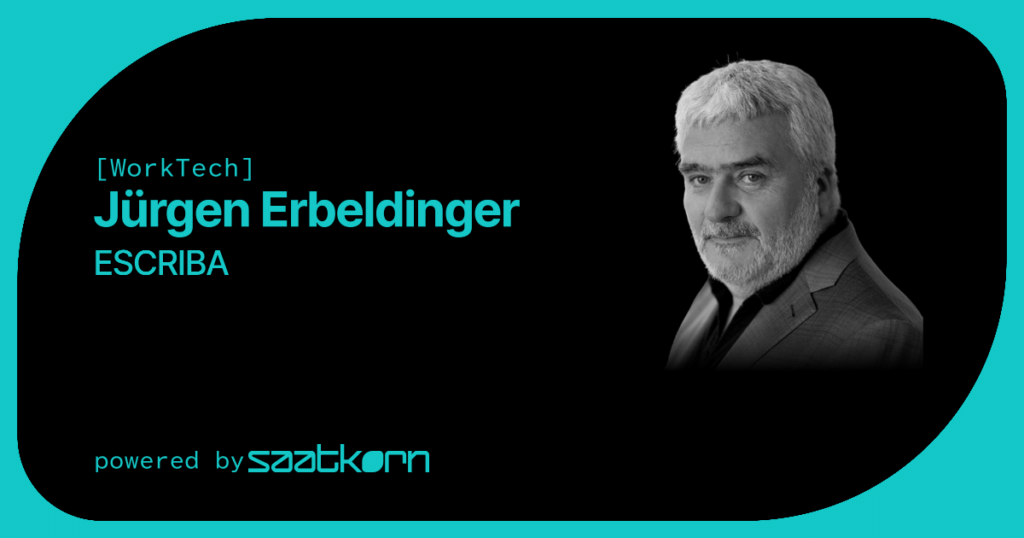
A new study by the market research institute Bilendi, published in June 2026 on behalf of ESCRIBA, surveyed 1,037 employees in Germany on the topic of AI use in the workplace. I had the opportunity to speak to ESCRIBA’s Managing Director, Dr Jürgen Erbeldinger, about this. Let’s get started. SAATKORN: Dear Jürgen – your study shows that almost one in two people use AI tools at work that have not been authorised by their employer at all. To put it another way: employees are already far ahead of their companies. Do you therefore see ‘shadow AI’ primarily as a security issue – or rather as proof that many companies are missing the boat when it comes to the AI transformation?
Both. Our survey shows that it is not only companies that are under pressure to adopt artificial intelligence, but employees too. The results can be interpreted to mean that the pressure amongst employees is greater than the pace of the AI transformation within companies. So employees simply turn to ‘shadow AI’, just as they used to turn to ‘shadow IT’ solutions when digitalisation wasn’t happening fast enough. This naturally creates security issues: 42.7 per cent of shadow AI users have already entered drafts of internal emails there, 15.7 per cent have entered strategic information on projects, products or customers, and as many as 12.9 per cent have entered customer data. But that’s not all. Companies face the mammoth task of initiating the AI transformation – yet many of them haven’t even properly completed their digitalisation yet.
SAATKORN: Ban, block or enable? Many companies still rely on control rather than trust when it comes to AI. Given the rapid pace of development of ChatGPT and similar tools, is this even realistic anymore, or are companies thereby creating precisely the ‘shadow AI’ they actually want to prevent?
Bans are necessary and, in many cases, sensible, but they do not solve the problem. After all, the AI transformation is not just about ChatGPT and the like. The true potential of AI only unfolds when I can use, analyse and evaluate AI-supported data in a secure environment. This requires connections to the data systems used in the relevant field of work – and appropriate data quality. In HR, for example, these are HCM systems. This, in turn, is not a use case for off-the-shelf LLM providers or the average AI user; from a data protection perspective, it is too risky or simply inadmissible. For instance, the use of LLMs from the US offers no reliable protection of personal data against access by third parties. But despite all the problems, yes: bans without a parallel AI transformation have led to the current situation.
Is HR in the driver’s seat – or in the back seat?
SAATKORN: Over 60 per cent of employees want clear guidelines and further training. At the same time, HR often seems to be more of a spectator than a shaper when it comes to the AI transformation. Is this a missed opportunity? In your opinion, what role should HR play in future?
When it comes to AI, most employees don’t really think so much about this integration with digital systems, but rather about searching for information (71.4 per cent according to our survey) or revising texts (65.5 per cent). These applications are also useful and can improve work within companies – both in terms of quality and efficiency within the workplace. However, employees should be able to do more than just enter prompts to some extent. AI is widely used in Germany, but I would describe the average level of user expertise as rather low. Naturally, this is a task for HR, and not just in the context of further training. HR traditionally operates at the interface between organisation, processes, roles and culture, and therefore finds itself in a natural leadership role in the current AI transformation. If AI not only automates tasks but also prepares decisions, structures discussions, makes knowledge accessible and increases process reliability, then HR becomes a co-creator of a new organisational order. It is no longer ‘People & Culture’ alone, but rather ‘Culture, IT/AI and People’ that describes the task now facing HR.
SAATKORN: If employees are moving faster than management, IT and compliance, a parallel world will inevitably emerge. Who is currently the biggest stumbling block on the path to productive AI use: senior management, data protection, IT or simply a lack of courage?
Among the corporate functions listed, I would definitely include HR. HR should be the driving force here, not the one being driven. What is crucial for HR is not teaching employees how to use individual systems (which is not wrong, but secondary), but understanding what impact AI has structurally on work, responsibilities and value creation. Precisely because the barriers to entry are being lowered by systems that can be operated using natural language – and which no longer require in-depth programming knowledge to use – HR has the opportunity to move beyond a purely operational role and play an active part in shaping the transformation. ‘Data protection’ is of fundamental importance, but currently still often serves as a pretext for doing nothing or postponing action.
Rules are not enough – companies need an AI operating system
SAATKORN: Many companies are currently discussing AI governance. To be honest, to many employees this sounds more like new rules than more innovation. In your view, what does governance look like that ensures security without stifling enthusiasm for AI within the company?
Employees do indeed want rules – our survey shows that too. Here, however, we must distinguish between ‘rules’ on the one hand and ‘bans’ on the other. Anyone who generally prohibits the use of AI within the company and believes they have thereby already made a decisive contribution to the issue is misjudging the situation. Rules are important, but in the sense of regulated use within environments that are as secure as possible. It is important to embed AI expertise as a widespread practice within the organisation, for example when employees use tools for text creation, research or human-machine brainstorming. But all of this is relatively pointless if I do not give fundamental thought to the role AI applications will play in the future of work.
SAATKORN: Today, AI primarily dominates research and text generation. Tomorrow, AI agents could take over entire processes. In your view, are we currently on the cusp of the real revolution in knowledge work – and are many companies still underestimating this next step in development?
That is our impression too. Setting up AI agents is, after all, no longer rocket science these days. But even so, according to our survey, only a minority – 28.5 per cent – feel confident enough to do so. Incidentally, based on my observations, the greatest potential for efficiency gains within HR itself lies in personnel administration. I agree with Professor Rump on this point
(potential for substitution through digital automation and AI
). This is where HR could provide a particularly compelling use case. To do so, however, I need different – and significantly more advanced – skills than simply being able to create an agent in ChatGPT, as well as other technical solutions and connections to the data systems used there. With the ESCRIBA Enterprise Agent Network (EAN), we have just launched an AI-powered automation platform for HR. EAN helps HR to automate recurring workflows, connect the various systems used in HR, and implement processes more quickly – without having to delve deep into programming every time.
Why successful companies organise AI in a completely different way
SAATKORN: You support numerous companies on their AI journey. When you sit in board meetings: what distinguishes organisations that really use AI strategically from those that merely talk about AI? Are there two or three common patterns among successful companies?
In my experience, the most important thing is that staff do not work with AI in isolation, but that everyone accesses the same system and the associated knowledge databases. The second key element is that the prompt does not go directly to the model, but first runs through a check. This check verifies whether the prompt complies with the rules, whether the machine – the AI – can assist with or take over the task, and whether this actually adds value. We see all too often that AI is used simply to ask, ‘What’s the weather going to be like tomorrow?’ Using AI for that is simply too expensive.
Dr Jürgen Erbeldinger: Shaping the future of work
SAATKORN: To conclude, let’s take a look into the future: let’s imagine we’re having this conversation again in three years’ time. Which development would positively surprise you – and which would, in your view, prove that Germany has made the leap from AI euphoria to genuine AI transformation?
I’d like to return to my earlier point here that HR actually has a natural leading role to play in AI transformation. If HR seizes this opportunity, the function can significantly expand its role as an architect of work and culture within organisations – evolving into a force that not only shapes culture but also redefines the new operational infrastructure of work, productivity and collaboration between humans and machines. Ideally, HR departments in Germany may not produce the best large language models, but they will come up with the most intelligent implementation scenarios. HR understands the fundamentals of such transformation processes: from upskilling and team development to employment law issues. The ability to adapt is likely to be the decisive competitive advantage for companies in the future. An HR department that masters this competence and continuously develops it will remain indispensable in the future. However, if HR departments slow down this development, they risk losing their relevance: Other functions will then define how AI is used, how productivity is generated and how tasks are distributed between people and machines – both within and outside HR. Companies that make truly productive use of artificial intelligence have a clear understanding of value, governance and compliance. This means they know what artificial intelligence is and what it can do; they have established a company-wide, uniform AI operating system; and they have laid down clear rules on how AI can and should be used in day-to-day work. HR can and must make a decisive contribution to such a structure.
SAATKORN: Dear Jürgen – thank you very much for the interview – and we wish you continued enjoyment and success with ESCRIBA!
Further links:
- Dr Jürgen Erbeldinger on LinkedIn
- ESCRIBA website
- Anyone interested can sign up to receive the white paper on the survey:
escriba.de/ki-nutzung-am-arbeitsplatz