

I have been following Joachim Rotzinger and Ingentis on SAATKORN for many years now. What inspires me about Joachim and his team is that, whilst many in the HR tech market talk about processes, recruitment or AI, Ingentis consistently takes organisational thinking a step further – in a data-driven, strategic way and with a clear focus on business success. This made me all the more eager to see the new Organisational Performance Report 2026. In this interview, we discuss why good organisational design is a genuine competitive advantage, why Germany lags behind the US, and what conclusions companies should draw from this now. Let’s get started: SAATKORN: Joachim, please introduce yourself briefly to the few SAATKORN readers who don’t know you.
Gladly. My name is Joachim Rotzinger; I’m the CEO of the software provider Ingentis. For more than 20 years, I’ve been working in HR tech and exploring how companies can make their organisations fit for the future. At Ingentis, we help companies to sustainably improve their organisational performance – in other words, to make organisations more efficient, adaptable and future-proof. To achieve this, we combine organisational analytics, organisational design and strategic workforce planning on an integrated platform. Our solutions provide transparency regarding corporate structures and workforce data, enabling comprehensive analyses of how well the corporate structure aligns with strategic objectives. Building on this, we enable data-driven simulations of future scenarios, thereby helping companies make better organisational decisions. More than 2,000 medium-sized and enterprise-level companies worldwide in over 50 countries are already using our platform, and we are delighted to see steady global growth.
Why organisational performance needs to be on the agenda now

SAATKORN: The Organisational Performance Report 2026 was published a few weeks ago. Why is this study needed, and who was surveyed?
We are seeing companies invest a great deal of energy in talent, leadership and culture. The design of the organisation itself, however, is often still underestimated. Yet it is precisely this that determines whether people can give their best: Dave Ulrich has shown that organisational design has around four times greater influence on business success than individual talent alone. McKinsey’s ‘State of Organisations Report’ has brought this topic more firmly into the international spotlight. Nevertheless, answers to some key questions have been lacking until now. Namely: how does good organisational design contribute to a company’s performance, what factors influence this performance, and what is the current situation in our companies? So, in the spring, together with Professor Dr Stephan Fischer from Pforzheim University, we conducted an online survey of some 1,200 employees in German and American companies with more than a thousand staff members. There were 605 respondents in the US and 621 in Germany. Among them were 110 managers across three hierarchical levels in Germany and 101 in the US.
SAATKORN: How do you define ‘organisational performance’?
Put simply, we understand it to mean the contribution to business success that can be explained by the way an organisation is structured – that is, through its structures, responsibilities, collaboration, decision-making processes and the way people interact within the organisation. The model on which Stephan Fischer bases his calculations, by contrast, is somewhat more complex. It draws on studies of ‘High Performance Work Systems’ and defines organisational performance as the interplay of four drivers – namely, efficiency, goal orientation, the organisation’s capacity to foster innovation and its adaptability – as well as three dimensions of impact: personnel performance, productive performance and financial performance.
Germany is falling behind
SAATKORN: What are the key findings of the report?
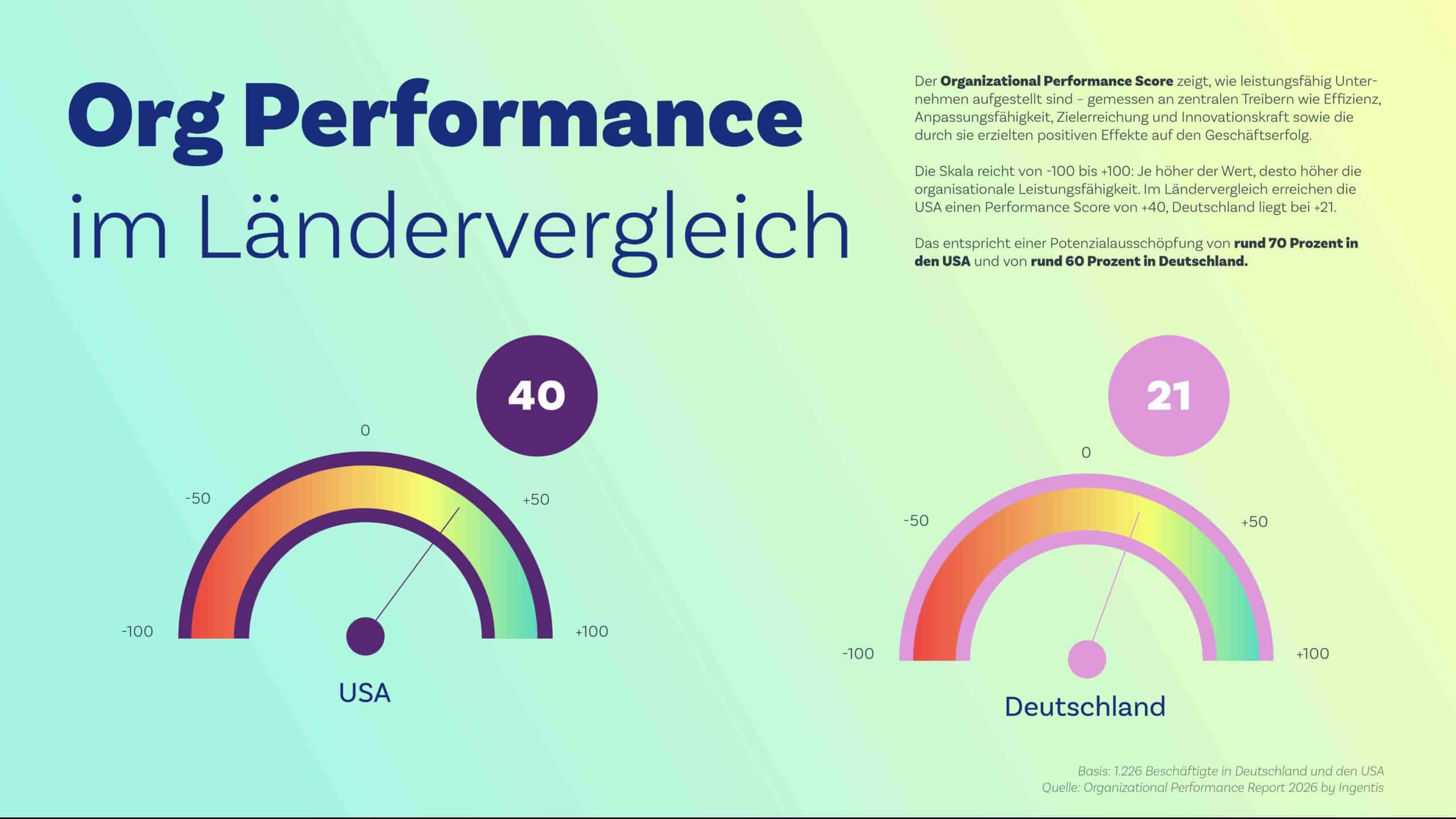
The most important finding is that neither American nor German companies are realising their potential for organisational performance to a satisfactory degree. According to our survey, this is achieved in the US by only 70 per cent of companies, whilst in Germany – a country that once saw itself as the world champion of organisation – the figure is as low as 60 per cent. In almost all drivers and dimensions of effect, the Germans lag significantly behind their US counterparts. This gap compared with the US can be explained in particular by the fact that the Germans surveyed demonstrate less awareness of and appreciation for organisational issues per se, recognise discernible shortcomings in their ability to manage change and reorganisation, and place less value on and make less use of data-driven methods of visualisation, analysing and designing organisational aspects than their transatlantic peers.
SAATKORN: Which findings surprised you the most?
There are actually a few details that I find particularly alarming. For example, the fact that just under 17 per cent of Germans surveyed perceive reorganisations as successful, that almost one in two respondents in Germany say reorganisations are laborious and protracted, and that only one in three recognise the importance of organisational design for future business success. By way of comparison: in the US, just under 56 per cent of respondents recognise this importance. And what’s most alarming about this is that these weaknesses not only weigh on business success, but also on morale! Satisfaction and confidence levels in the US are just under ten percentage points higher than in Germany. And they correlate directly with organisational capability and the success of reorganisations. We are truly squandering enormous potential that we could realise without external influences – simply by organising and reorganising more effectively.
Three specific recommendations for businesses
SAATKORN: What strategic recommendations for action do you draw from the report for companies, particularly in Germany?
Firstly:
View organisation as a booster for performance and satisfaction! Adaptable, goal-oriented, innovation-friendly and efficient structures and processes are a competitive advantage.
Secondly:
Consider organisational and workforce aspects together! What use are the right talents in the right place at the right time if they do not find the right environment there in which to perform at their best?
Thirdly:
Make decisions and shape the future based on data! We have all the necessary data within our organisations to set up structures and workforces in a way that enhances performance. We simply do not make enough use of it or, as the study also shows, we approach it with the wrong mindset: Germans, in particular, still rely heavily on data for documentation, planning and updating. By contrast, US respondents demonstrate a more transformative attitude. They use their data slightly more frequently for forecasting, simulating and restructuring.
Download link for the report
SAATKORN: Where can the report be downloaded?
It’s available on our website
. We’re delighted to support anyone who wants to better understand and specifically harness their organisation’s potential. We hope the report will provide plenty of helpful insights for this purpose.
SAATKORN: Joachim, thank you very much for the interview, and we wish you continued enjoyment and success with Ingentis!