

HR Suites have been gaining in importance for some time now. AI, increasing complexity and the desire for integrated data landscapes are playing into the hands of platform providers. But does this really spell the end of best-of-breed solutions?
Our latest SAATKORN WorkTech Insights, a conversation with Jens Bender, recent market studies and a LinkedIn survey paint a more nuanced picture.
SAATKORN WorkTech Insights: 16,342 events in the last 30 days
First, a look at our latest usage figures: over the past 30 days, we have recorded a total of 16,342 WorkTech events on SAATKORN.
These include:
- 8,067 profile comparisons
- 5,431 profile views
- 2,677 match recommendations
- 96 RFI uploads
I find it particularly interesting that almost half of all events relate to provider and product comparisons. Our visitors are therefore not just looking at individual providers, but are making extensive use of SAATKORN to compare solutions and find their way around the WorkTech market.
Of course, events do not equate to unique users, nor do they represent purchasing decisions. However, the figures do show which features of our platform are being used most intensively.
The most viewed HR suites on SAATKORN
Our current SAATKORN WorkTech Visibility Ranking as at 21 November 2026
looks as follows:
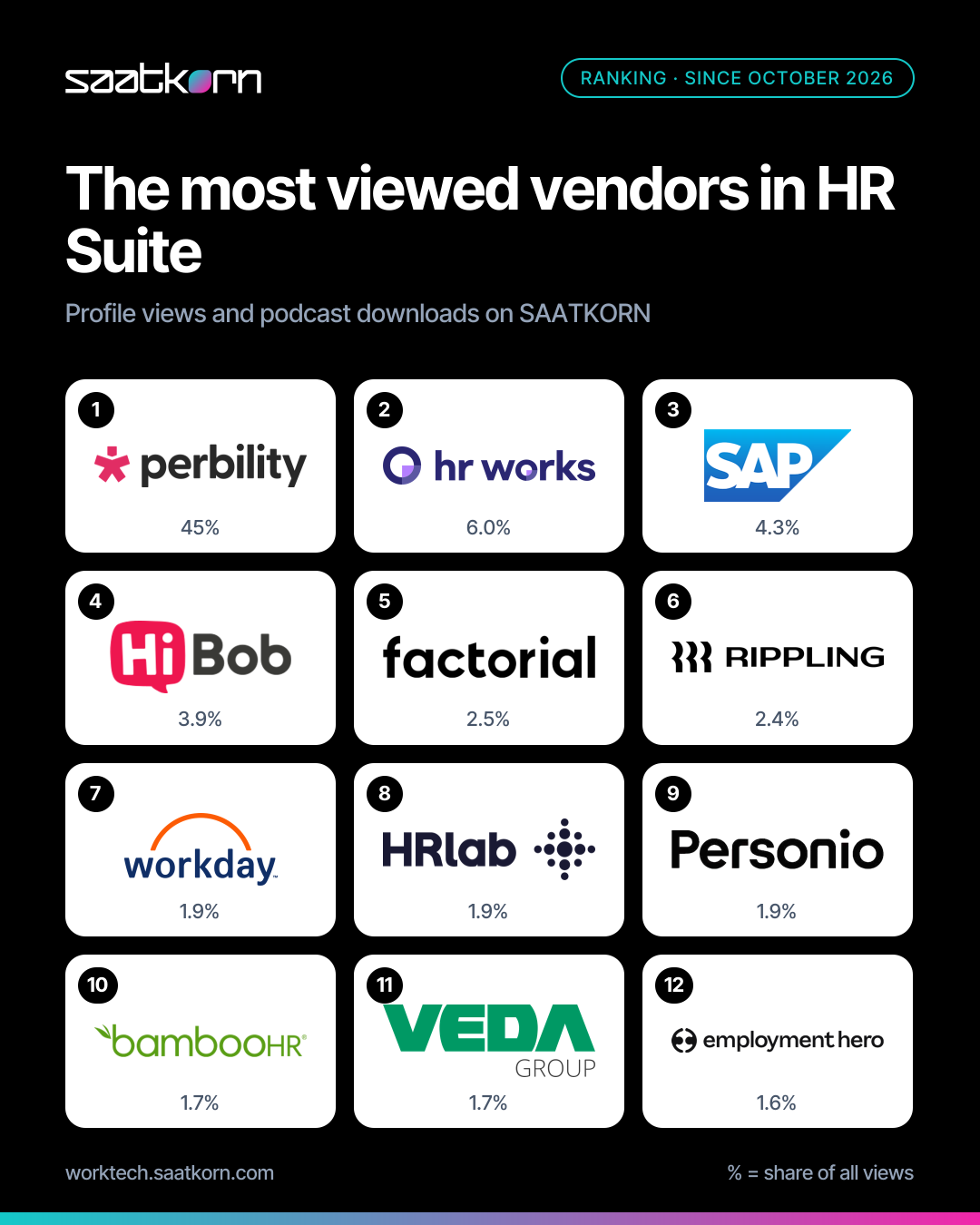
Important: The ranking measures visibility within the SAATKORN ecosystem; it does not measure market share or product quality.
There is, of course, a specific reason for Perbility’s huge lead: my podcast with Perbility CEO Sophie Genty has attracted an exceptionally high level of interest.
I find that remarkable. It shows that the people, strategies and entrepreneurial stories behind WorkTech providers can be at least as interesting as their products. Personal insights into market changes, challenges and future plans clearly attract a great deal of attention. For me, it is precisely these kinds of conversations that make SAATKORN so appealing.
HR Suites are benefiting – according to the HR business climate survey
In line with this, I recently spoke with Jens Bender from WorkTech Advisory on the podcast about the latest HR business climate survey.
The results are fascinating: the business climate index for HR tech providers has fallen from 56 to 45 points, although the current business situation continues to be viewed positively.
Particularly interesting for our discussion: four out of five integrated HR suite providers expect double-digit growth rates. Among specialised point-solution providers, by contrast, it is only around one in two.
More than two-thirds of the providers surveyed are also observing a consolidation of their clients’ HR tech budgets.
This suggests that companies are increasingly scrutinising their software landscapes and that integrated platforms currently hold a competitive advantage. However, the growth figures are expectations, not revenue already realised.
What do recent studies say?
International research also supports the view that integrated HR platforms are becoming increasingly strategically important.
I find the Mercer HR Tech Confidence Check from spring 2026 particularly interesting: 77.6 per cent of the companies surveyed are investing in core HR. At the same time, only 14 per cent regard their HR system landscape as truly coherent and interoperable. This is precisely where the potential of integrated platforms lies. After all, AI requires reliable data, clear authorisations and coherent processes.
The ISG HCM Suites Buyers Guide 2026 therefore increasingly describes HR suites as a central control layer for workforce data, identities and workflows. However, this does not mean that everything will have to come from a single source in future.
On the contrary: in its November 2026 study, Forrester describes hybrid core-and-edge architectures as the most common strategy for enterprise applications. I find the logic behind this convincing: an integrated platform forms the foundation for centralised data and processes. Specialised solutions complement this where they deliver clear functional added value.
The future therefore probably lies less in the traditional all-in-one model than in a strong technological core with an open ecosystem.
And what does the SAATKORN Community say?
In line with this discussion, I asked our LinkedIn community whether there is a clear trend towards HR suites or best-of-breed approaches. The result:
31 per cent focus on HR suites, 31 per cent on best-of-breed approaches and 36 per cent favour hybrid approaches.
No clear trend is apparent here. Of course, a LinkedIn survey is not representative. Nevertheless, it shows that even within our community there is no clear preference for just one approach.
My conclusion
Strong Core. Open Ecosystem. Smart WorkTech.
For me, all of this leads to the following conclusions:
- HR suites are gaining strategic importance.
Increasing pressure for integration, fragmented data landscapes and AI are strengthening the role of central HR platforms. The latest HR business survey provides an interesting market signal in this regard. - Best-of-breed solutions remain relevant.
Specialised providers will continue to be needed where they offer superior functionality or better meet specific requirements. The key question is whether the added value they provide justifies the additional complexity. - The future belongs to intelligent ecosystems.
It is not the number of functions that matters, but the quality of the data, the integration of processes and the ability to utilise AI effectively. My impression is that the ‘HR suite or best-of-breed?’ debate falls short.
The really exciting question is: Who will manage to build an intelligent, integrated WorkTech ecosystem from a strong technological core and the right specialist solutions?
In my view, this is precisely what will be one of the key questions for 2027.