

Overall SAATKORN WorkTech Key Figures
Let’s start with a brief look at the general SAATKORN key figures: over the last 30 days, SAATKORN recorded 12,370 interactions on the platform. This breaks down largely as follows:
✅ 4,514 profile views by WorkTech providers
✅ 4,801 comparisons between WorkTech products
✅ 2,860 match recommendations
✅ 96 RFI downloads
✅ plus 5,540 podcast streams.
These figures relate to SAATKORN as a whole. Now let’s move on to the
Health & Wellbeing category
This week, I’m focusing on the WorkTech category ‘Health & Wellbeing’: which providers are attracting attention, and what does the range of services tell us about the decisions HR teams are facing?
🥇 Bloom tops the SAATKORN visibility ranking with 11 per cent,
🥈 followed by voiio with 7.1 per cent.
🥉 The Fürstenberg Institute and Health Clapp each account for 6.3 per cent.
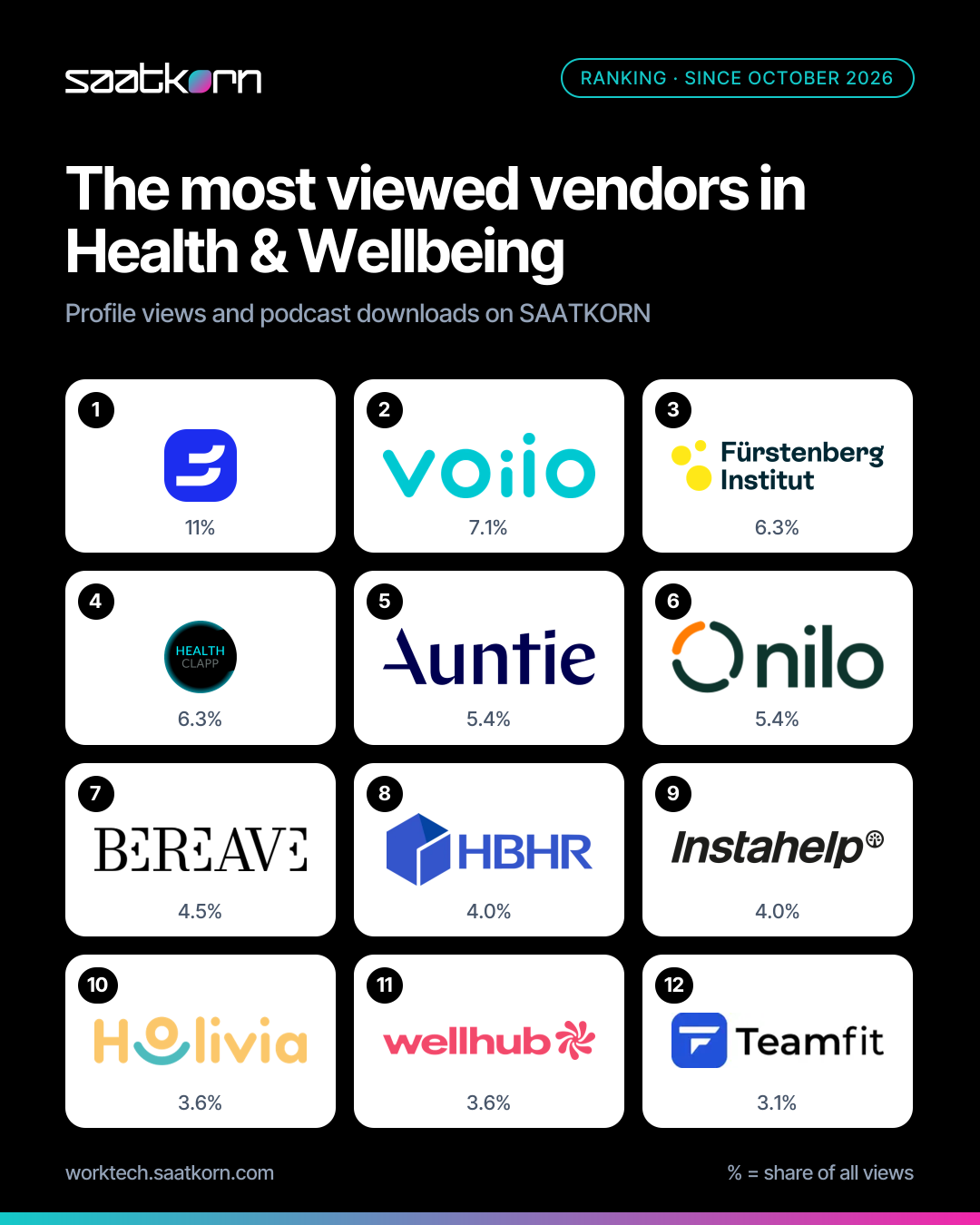
At the top of the chart, you can see the top 12 health and wellbeing providers on SAATKORN. The ranking combines category-specific profile views and podcast downloads since the directory was launched in October 2026. It measures the level of attention on SAATKORN.
Wide range
The Top 12 encompass mental health support, employee assistance programmes, services for families and life stages, as well as more comprehensive wellbeing platforms. This breadth is important when an HR team begins to compare providers: an employee seeking confidential counselling needs a different kind of support to someone looking for care for a family member. Market consolidation is expanding some portfolios, as demonstrated by Wellhub’s acquisition of Urban Sports Club. Beyond the top 12, the ‘Health & Wellbeing’ category currently comprises a longlist of 21 further providers.
What employers should consider
The sheer number of providers raises a practical question: which issues should employers tackle first?
- In the Randstad Workmonitor 2026, 45 per cent of German employees rated their employer’s support for mental health as important or very important – a decline from 85 per cent in 2024.
- The 2026 Randstad-ifo HR Survey sheds light on the situation from the employer’s perspective. Around 51 per cent of German companies reported increasing mental strain and stress amongst their staff, with economic uncertainty (49 per cent) and organisational changes (45 per cent) cited as the most common causes.
- The AOK Absenteeism Report 2026 provides a measure of the strain: days lost due to mental health issues amongst AOK policyholders rose by almost 42 per cent between 2016 and 2025. In 2025, the average number of days absent due to a mental health diagnosis was 28.5 days.
The studies measure different aspects: what employees value, what companies observe, and how much time people are absent. For HR departments, the gap between the stated priorities and the reported stress levels is a reason to examine closely how a scheme would work in practice: Can employees get help quickly? Will they trust the support enough to use it? Can the employer analyse the results whilst protecting individual privacy? Workload and leadership belong in the same discussion, particularly when stress arises from the way work is organised.
How the SAATKORN community sees it
This week, I also asked the SAATKORN LinkedIn community how important health and wellbeing are for employers in 2026. The results:
- 73 per cent: “A business-critical priority”
- 15% “An important employee benefit”
- 10% “Less relevant in today’s market”.
If health and wellbeing are a business priority, find out more about providers in the “Health & Benefits” category. You can get started HERE with the SAATKORN WorkTech Directory to compare providers in this category.
Are you a provider and is your company not yet listed?
New WorkTech providers are constantly entering the market. If your company isn’t listed yet, add it HERE to the SAATKORN WorkTech Directory. A basic listing is free of charge.