


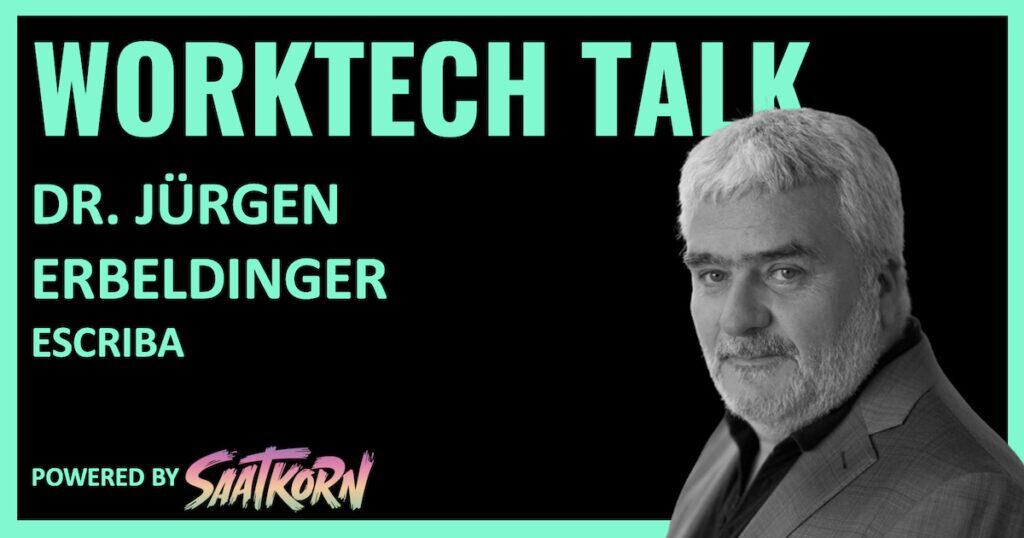
Studie: KI Nutzung am Arbeitsplatz – Interview mit Dr. JÜRGEN ERBELDINGER
English version below
Eine neue Studie des Marktforschungsinstituts Bilendi aus Juni 2026 im Auftrag von ESCRIBA befragte 1.037 Beschäftigte aus Deutschland zum Themenfeld KI Nutzung am Arbeitsplatz. Ich hatte Gelegenheit, dazu mit ESCRIBA Geschäftsführer Dr. Jürgen Erbeldinger zu sprechen. Auf geht’s.
SAATKORN: Lieber Jürgen – Eure Studie zeigt: Fast jede zweite Person nutzt im Job KI-Tools, die vom Arbeitgeber gar nicht freigegeben wurden. Anders formuliert: Die Mitarbeitenden sind längst weiter als ihre Unternehmen. Ist Schatten-KI für Sie deshalb vor allem ein Sicherheitsproblem – oder vielmehr der Beweis dafür, dass viele Unternehmen die KI-Transformation verschlafen?
Sowohl als auch. Unsere Umfrage zeigt, dass nicht nur Unternehmen unter dem Druck stehen, Künstliche Intelligenz einzusetzen, sondern auch die Mitarbeitenden. Die Ergebnisse kann man so interpretieren, dass der Druck unter den Mitarbeitenden größer ist als die Geschwindigkeit der KI-Transformation in den Unternehmen. Dann weichen die Mitarbeitenden eben auf „Schatten-KI“ aus, so wie sie früher auf „Schatten-IT“-Lösungen ausgewichen sind, wenn es nicht schnell genug ging mit der Digitalisierung. Das schafft natürlich Sicherheitsprobleme: 42,7% der Schatten-KI-Nutzenden haben dort schon einmal Entwürfe für interne E-Mails eingegeben, 15,7% strategische Informationen zu Projekten, Produkten oder Kunden und Kundendaten immerhin 12,9%. Aber das ist es nicht nur. Unternehmen stehen vor der Mammutaufgabe, die KI-Transformation einzuleiten – dabei haben viele von ihnen die Digitalisierung noch nicht einmal richtig abgeschlossen.
SAATKORN: Verbieten, blockieren oder ermöglichen? Viele Unternehmen setzen beim Thema KI noch immer auf Kontrolle statt auf Vertrauen. Ist das angesichts der Dynamik von ChatGPT & Co. überhaupt noch realistisch oder produzieren Unternehmen damit genau die Schatten-KI, die sie eigentlich verhindern wollen?
Verbote sind nötig und in vielen Fällen sinnvoll, lösen aber das Problem nicht. Es geht bei der KI-Transformation ja nicht nur um ChatGPT & Co. Das eigentliche Potenzial der KI entfaltet sich erst, wenn ich in einer sicheren Umgebung KI-gestützt Daten nutzen, analysieren und auswerten kann. Dafür sind Anschlüsse an die im jeweiligen Arbeitsgebiet eingesetzten Datensysteme notwendig – und eine entsprechende Datenqualität. Im HR sind das zum Beispiel HCM-Systeme. Das wiederum ist kein Anwendungsfall für die handelsüblichen Anbieter von LLMs sowie den durchschnittlichen KI-User und aus der Perspektive des Datenschutzes zu risikobehaftet oder schlicht unzulässig. So bietet zum Beispiel der Einsatz von LLMs aus den USA keinen zuverlässigen Schutz persönlicher Daten vor einem Zugriff Dritter. Aber trotz aller Probleme, ja: Verbote ohne parallele KI-Transformation haben zur jetzigen Situation geführt.
HR sitzt am Steuer – oder auf der Rückbank?
SAATKORN: Über 60 Prozent der Beschäftigten wünschen sich klare Leitplanken und Weiterbildung. Gleichzeitig scheint HR bei der KI-Transformation häufig eher Zuschauer als Gestalter zu sein. Ist das eine vertane Chance? Welche Rolle sollte HR Deiner Meinung nach künftig spielen?
Die meisten Mitarbeitenden denken beim Thema KI gar nicht so sehr an diese Vernetzung mit digitalen Systemen, sondern an die Recherche von Informationen (71,4% laut unserer Umfrage) oder das Überarbeiten von Texten (65,5%). Auch diese Anwendungen sind sinnvoll und können die Arbeit in Unternehmen verbessern – sowohl im Hinblick auf die Qualität als auch die Effizienz im System Arbeit. Mitarbeitende sollten dafür aber mehr können als einigermaßen zu prompten. In Deutschland wird viel KI genutzt, aber das durchschnittliche User-Know-how würde ich eher als niedrig veranschlagen. Natürlich ist das eine Aufgabe für HR, nicht nur in der Weiterbildung. HR arbeitet traditionell an der Schnittstelle von Organisation, Prozessen, Rollen und Kultur und befindet sich daher in einer natürlichen Führungsrolle bei der aktuellen KI-Transformation. Wenn KI nicht nur Aufgaben automatisiert, sondern auch Entscheidungen vorbereitet, Gespräche strukturiert, Wissen zugänglich macht und Prozesssicherheit erhöht, dann wird HR zum Mitgestalter einer neuen betrieblichen Ordnung. Nicht mehr „People & Culture“ allein, sondern eher „Culture, IT/KI and People“ beschreibt die Aufgabe, die jetzt vor HR liegt.
SAATKORN: Wenn Mitarbeitende schneller sind als Management, IT und Compliance, entsteht zwangsläufig eine Parallelwelt. Wer ist aktuell der größte Bremsklotz auf dem Weg zur produktiven KI-Nutzung: die Unternehmensführung, Datenschutz, IT oder schlicht fehlender Mut?
Bei den aufgezählten Unternehmensfunktionen würde ich unbedingt HR mit aufzählen. HR sollte hier Treiberin sein, nicht Getriebene. Entscheidend für HR ist nicht, Beschäftigten die Bedienung einzelner Systeme beizubringen (das ist auch nicht falsch, aber nachgeordnet), sondern zu verstehen, was KI strukturell mit Arbeit, Zuständigkeiten und Wertschöpfung macht. Gerade weil die Einstiegshürden durch Systeme sinken, die sich durch natürliche Sprache bedienen lassen und für deren Anwendung man keine tiefen Programmierkenntnisse mehr benötigt, eröffnet sich für HR die Chance, aus der reinen Anwendungsrolle herauszutreten und die Transformation aktiv mitzuprägen. „Datenschutz“ ist fundamental wichtig, dient aber aktuell noch häufig als Vorwand, nichts zu tun oder Aktivitäten aufzuschieben.
Regeln reichen nicht – Unternehmen brauchen ein KI-Betriebssystem
SAATKORN: Viele Unternehmen sprechen derzeit über AI Governance. Ehrlich gesagt klingt das für viele Mitarbeitende eher nach neuen Regeln als nach mehr Innovation. Wie sieht aus Deiner Sicht eine Governance aus, die Sicherheit schafft, ohne die Lust auf KI im Unternehmen abzuwürgen?
Mitarbeitende wünschen sich ja durchaus Regeln – auch das zeigt unsere Umfrage. Hier müssen wir aber zwischen „Regeln“ auf der einen Seite und „Verboten“ auf der anderen Seite unterscheiden. Wer den Einsatz von KI im Unternehmen generell untersagt und meint, er habe damit schon den entscheidenden Beitrag zum Thema geleistet, verkennt die Situation. Regeln sind wichtig, aber im Sinn eines geregelten Einsatzes in größtmöglich geschützten Umgebungen. Die Verankerung von KI-Know-how als Breitensport im Unternehmen ist wichtig, etwa wenn Mitarbeitende Tools zur Texterstellung, Recherche oder für das Mensch-Maschine-Brainstorming nutzen. Aber das alles ist relativ sinnlos, wenn ich mir keine grundsätzlichen Gedanken darüber mache, welche Rolle KI-Anwendungen künftig im System Arbeit spielen.
SAATKORN: Heute dominiert KI vor allem Recherche und Texterstellung. Morgen könnten KI-Agenten komplette Prozesse übernehmen. Stehen wir Deiner Einschätzung nach gerade vor der eigentlichen Revolution der Wissensarbeit – und unterschätzen viele Unternehmen diesen nächsten Entwicklungsschritt noch?
Das ist auch unser Eindruck. Die Einrichtung von KI-Agenten ist ja nun heute auch keine Raketenwissenschaft mehr. Aber selbst das traut sich nach unserer Umfrage nur eine Minderheit von 28,5% zu. Das größte Effizienz-Potenzial in HR selbst schlummert meiner Beobachtung nach übrigens in der Personalverwaltung. Da gebe ich Professorin Rump recht (Substitutionspotenzial durch digitale Automatisierung und KI). Hier könnte HR einen besonders überzeugenden Use Case liefern. Dafür brauche ich aber andere, und deutlich tiefere Skills als in ChatGPT einen Agenten anlegen zu können – und auch andere technische Lösungen sowie Anschlüsse an die dort verwendeten Datensysteme. Mit dem ESCRIBA Enterprise Agent Network (EAN) haben wir gerade eine KI-gestützte Automatisierungsplattform für HR auf den Markt gebracht. EAN hilft HR dabei, wiederkehrende Abläufe zu automatisieren, in HR verwendete Systeme miteinander zu verbinden und Prozesse schneller umzusetzen – ohne dafür jedes Mal tief in die Programmierung einsteigen zu müssen.
Warum erfolgreiche Unternehmen KI völlig anders organisieren
SAATKORN: Du begleitest zahlreiche Unternehmen auf ihrem KI-Weg. Wenn Du in Vorstandssitzungen sitzt: Was unterscheidet Organisationen, die KI wirklich strategisch nutzen, von denen, die lediglich über KI reden? Gibt es zwei oder drei gemeinsame Muster erfolgreicher Unternehmen?
Aus meiner Erfahrung das Wichtigste ist, dass die Mitarbeiter:innen nicht isoliert mit der KI arbeiten, sondern alle auf das gleiche System und die dazugehörigen Wissens-Datenbanken zugreifen. Das zweite zentrale Element ist, dass der Prompt nicht direkt gegen das Modell geht, sondern zunächst eben durch einen Check läuft. Hier wird überprüft, ist der Prompt das regelkonform, kann die Maschine – die KI – bei der Erledigung der Aufgabe unterstützen oder dies übernehmen und ist das überhaupt wertschöpfend. Wir erleben oft genug, dass KI genutzt wird, um zu fragen, wie wird das Wetter morgen? Dafür ist KI-Nutzung einfach zu teuer.
Dr. Jürgen Erbeldinger: Wer die Zukunft der Arbeit gestaltet
SAATKORN: Zum Abschluss ein Blick in die Zukunft: Stellen wir uns vor, wir führen dieses Gespräch in drei Jahren erneut. Welche Entwicklung würde Dich positiv überraschen – und welche wäre für Dich der Beleg dafür, dass Deutschland den Sprung von der KI-Euphorie zur echten KI-Transformation geschafft hat?
Ich möchte hier meine Überlegung noch einmal aufgreifen, dass HR eigentlich eine natürliche Leadrolle bei der KI-Transformation zukommt. Wenn HR die Gelegenheit beim Schopf packt, kann die Funktion ihre Rolle als Arbeits- und Kulturarchitektin in Organisationen deutlich ausbauen – hin zu einer Instanz, die nicht nur Kultur begleitet, sondern auch die neue betriebliche Infrastruktur von Arbeit, Produktivität und Zusammenarbeit von Mensch und Maschine neu definiert. Im Idealfall kommen aus HR-Abteilungen in Deutschland dann zwar nicht die besten Large Language Modelle, aber die intelligentesten Umsetzungsszenarien. HR kennt die Grundlagen für solche Transformationsprozesse: vom Upskilling über die Teamentwicklung bis zu arbeitsrechtlichen Fragen. Die Fähigkeit, sich zu verändern, dürfte künftig der entscheidende Wettbewerbsvorteil für Unternehmen sein. Eine HR-Abteilung, die diese Kompetenz beherrscht und laufend ausbaut, ist auch künftig unverzichtbar. Wenn Personalbereiche diese Entwicklung aber ausbremsen, droht ihnen ein Bedeutungsverlust: Andere Funktionen definieren dann, wie KI eingesetzt wird, wie Produktivität entsteht und wie sich Aufgaben zwischen Menschen und Maschinen verteilen – in- und außerhalb von HR. Die Unternehmen, die künstliche Intelligenz wirklich produktiv nutzen, haben ein klares Verständnis von Wert, Governance und Compliance. Das heißt, sie wissen, was künstliche Intelligenz ist und kann, haben ein unternehmensweites, einheitliches KI-Betriebssystem aufgebaut und klare Regeln aufgestellt, wie KI im Arbeitsalltag genutzt werden kann und soll. Zu einer solchen Struktur kann und muss HR einen entscheidenden Beitrag liefern.
SAATKORN: Lieber Jürgen – vielen Dank für das Interview – und weiterhin viel Spaß und Erfolg mit ESCRIBA!
Weiterführende Links:
- Dr. Jürgen Erbeldinger LinkedIn
- ESCRIBA Website
- Interessierte können sich für das Whitepaper zur Umfrage vormerken lassen: escriba.de/ki-nutzung-am-
arbeitsplatz
Study: AI Use in the Workplace — Interview with Dr. JÜRGEN ERBELDINGER
A new study by the market research institute Bilendi, published in June 2026 and commissioned by ESCRIBA, surveyed 1,037 employees in Germany on the topic of AI use in the workplace. I had the opportunity to speak with ESCRIBA Managing Director Dr. Jürgen Erbeldinger about this. Let’s get started.
SAATKORN: Dear Jürgen—Your study shows that nearly one in two people use AI tools at work that haven’t been approved by their employer at all. In other words, employees are far ahead of their companies. Do you therefore view “shadow AI” primarily as a security issue—or rather as proof that many companies are falling behind on the AI transformation?
Both. Our survey shows that it’s not just companies that are under pressure to adopt artificial intelligence—employees are, too. The results can be interpreted to mean that the pressure on employees is greater than the pace of AI transformation within companies. So employees simply turn to “shadow AI,” just as they used to turn to “shadow IT” solutions when digitization wasn’t happening fast enough. This naturally creates security issues: 42.7% of shadow AI users have entered drafts of internal emails there at least once, 15.7% have entered strategic information about projects, products, or customers, and 12.9% have entered customer data. But that’s not all. Companies face the mammoth task of initiating the AI transformation—yet many of them haven’t even fully completed their digital transformation yet.
SAATKORN: Ban, block, or enable? When it comes to AI, many companies still rely on control rather than trust. Given the rapid evolution of ChatGPT and similar tools, is that even realistic anymore—or are companies actually creating the very “shadow AI” they’re trying to prevent?
Bans are necessary and, in many cases, sensible, but they do not solve the problem. After all, the AI transformation isn’t just about ChatGPT and similar tools. AI’s true potential only unfolds when I can use, analyze, and evaluate AI-supported data in a secure environment. This requires connections to the data systems used in the respective field of work—and corresponding data quality. In HR, for example, these are HCM systems. This, in turn, is not a use case for off-the-shelf LLM providers or the average AI user, and from a data protection perspective, it is too risky or simply impermissible. For instance, the use of LLMs from the U.S. offers no reliable protection of personal data against access by third parties. But despite all the problems, yes: bans without a parallel AI transformation have led to the current situation.
Is HR at the wheel—or in the back seat?
SAATKORN: Over 60 percent of employees want clear guidelines and further training. At the same time, HR often seems to be more of a spectator than a shaper of the AI transformation. Is this a missed opportunity? What role do you think HR should play in the future?
When it comes to AI, most employees don’t think so much about integration with digital systems, but rather about searching for information (71.4% according to our survey) or revising texts (65.5%). These applications are also useful and can improve work in companies—both in terms of quality and efficiency within the work system. However, employees should be able to do more than just provide basic prompts. AI is widely used in Germany, but I’d describe the average user’s level of expertise as rather low. Of course, this is a task for HR—and not just in the context of continuing education. HR traditionally operates at the intersection of organization, processes, roles, and culture, and therefore finds itself in a natural leadership role in the current AI transformation. If AI not only automates tasks but also prepares decisions, structures conversations, makes knowledge accessible, and increases process reliability, then HR becomes a co-creator of a new organizational order. It is no longer “People & Culture” alone, but rather “Culture, IT/AI, and People” that describes the task now facing HR.
SAATKORN: When employees move faster than management, IT, and compliance, a parallel world inevitably emerges. Who is currently the biggest roadblock on the path to productive AI use: corporate leadership, data protection, IT, or simply a lack of courage?
Among the corporate functions listed, I would definitely include HR. HR should be the driver here, not the one being driven. What’s crucial for HR isn’t teaching employees how to use individual systems (which isn’t wrong, but is secondary), but understanding what AI does structurally to work, responsibilities, and value creation. Precisely because the barriers to entry are lowering thanks to systems that can be operated using natural language—and for which in-depth programming knowledge is no longer required—HR has the opportunity to move beyond a purely operational role and actively shape the transformation. “Data protection” is fundamentally important, but it currently still often serves as an excuse to do nothing or to postpone action.
Rules aren’t enough—companies need an AI operating system
SAATKORN: Many companies are currently talking about AI governance. To be honest, to many employees, this sounds more like new rules than more innovation. In your view, what does governance look like that creates security without stifling enthusiasm for AI within the company?
Employees do want rules—our survey shows that, too. But here we must distinguish between “rules” on the one hand and “bans” on the other. Anyone who generally prohibits the use of AI in the company and thinks they’ve thereby made the decisive contribution to the issue is misjudging the situation. Rules are important, but in the sense of regulated use in environments that are as secure as possible. It’s important to embed AI expertise as a widespread practice within the company—for example, when employees use tools for text creation, research, or human-machine brainstorming. But all of this is relatively pointless if I don’t give serious thought to the role AI applications will play in the future of work.
SAATKORN: Today, AI primarily dominates research and text generation. Tomorrow, AI agents could take over entire processes. In your estimation, are we currently on the verge of the actual revolution in knowledge work—and are many companies still underestimating this next step in development?
That’s our impression as well. Setting up AI agents isn’t exactly rocket science these days. But according to our survey, only a minority—28.5%—feel confident enough to do so. Incidentally, based on my observations, the greatest potential for efficiency gains in HR itself lies in personnel administration. I agree with Professor Rump on this (Substitution Potential Through Digital Automation and AI). This is where HR could provide a particularly compelling use case. However, this requires different—and significantly more advanced—skills than simply creating an agent in ChatGPT, as well as other technical solutions and integrations with the data systems used there. With the ESCRIBA Enterprise Agent Network (EAN), we’ve just launched an AI-powered automation platform for HR. EAN helps HR automate recurring workflows, connect HR systems, and implement processes faster—without having to delve deeply into programming every time.
Why Successful Companies Organize AI Completely Differently
SAATKORN: You support numerous companies on their AI journey. When you’re in executive board meetings: What distinguishes organizations that truly use AI strategically from those that merely talk about AI? Are there two or three common patterns among successful companies?
In my experience, the most important thing is that employees don’t work with AI in isolation, but rather that everyone accesses the same system and the associated knowledge databases. The second key element is that the prompt doesn’t go directly to the model but first runs through a check. This check verifies whether the prompt complies with the rules, whether the machine—the AI—can assist with or take over the task, and whether this actually adds value. We see all too often that AI is used to ask, “What will the weather be like tomorrow?” Using AI for that is simply too expensive.
Dr. Jürgen Erbeldinger: Who Is Shaping the Future of Work
SAATKORN: To wrap up, let’s look to the future: Imagine we’re having this conversation again in three years. What development would positively surprise you—and what would be proof to you that Germany has made the leap from AI euphoria to genuine AI transformation?
I’d like to revisit my point here that HR actually has a natural leadership role to play in AI transformation. If HR seizes this opportunity, the function can significantly expand its role as an architect of work and culture within organizations—evolving into a force that not only shapes culture but also redefines the new operational infrastructure of work, productivity, and collaboration between humans and machines. Ideally, HR departments in Germany may not produce the best large language models, but they will come up with the most intelligent implementation scenarios. HR understands the fundamentals of such transformation processes: from upskilling and team development to labor law issues. The ability to adapt is likely to be the decisive competitive advantage for companies in the future. An HR department that masters this competency and continuously expands it will remain indispensable. However, if HR departments slow down this development, they risk losing their relevance: other functions will then define how AI is used, how productivity is generated, and how tasks are distributed between people and machines—both within and outside of HR. Companies that truly use artificial intelligence productively have a clear understanding of value, governance, and compliance. This means they know what artificial intelligence is and what it can do; they have established a company-wide, unified AI operating system; and they have set clear rules for how AI can and should be used in day-to-day work. HR can and must make a decisive contribution to such a structure.
SAATKORN: Dear Jürgen—thank you very much for the interview—and we wish you continued enjoyment and success with ESCRIBA!
Further links:
- Dr. Jürgen Erbeldinger LinkedIn
- ESCRIBA Website
- Those interested can sign up to receive the white paper on the survey: escriba.de/ki-nutzung-am-arbeitsplatz