


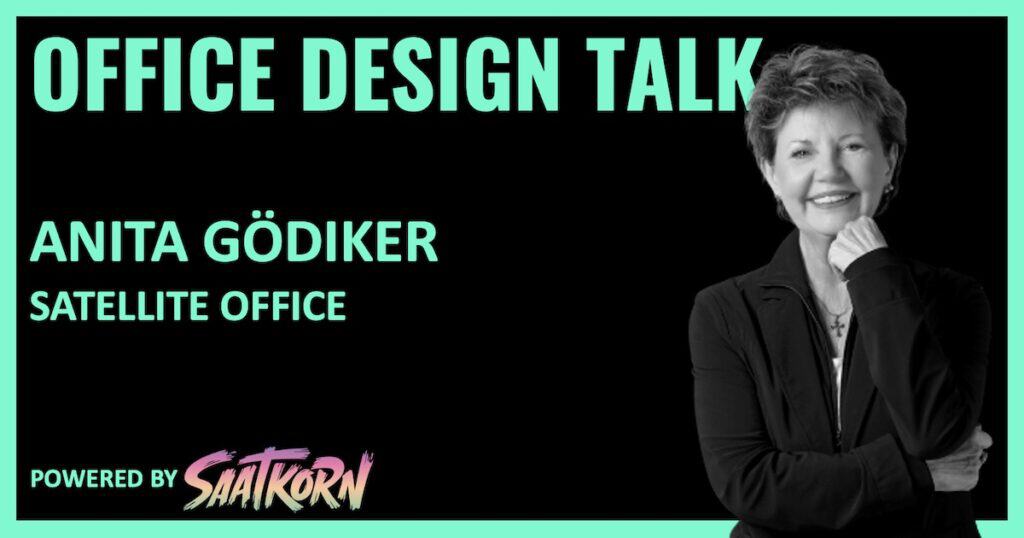
Studie: Büros im Jahr 2026 mit ANITA GÖDIKER
English version below
Satellite Office Gründerin und CEO Anita Gödiker spricht im SAATKORN-Interview über eine aktuelle Studie und darüber, warum das Büro auch im Zeitalter hybrider Arbeit nichts von seiner Bedeutung verloren hat – allerdings unter einer entscheidenden Voraussetzung. Im Mittelpunkt stehen Produktivität, Konzentration und die Frage, weshalb Ruhe heute zu den wichtigsten Erfolgsfaktoren moderner Wissensarbeit gehört. Ein spannendes Gespräch über Großraumbüros, KI, hybride Arbeit und die Zukunft des Arbeitsplatzes. Auf geht’s:
SAATKORN: Liebe Frau Gödiker, bitte stellen Sie sich und Satellite Office den SAATKORN Leser:innen kurz vor.
Ich bin Anita Gödiker, Gründerin und CEO von Satellite Office. Seit Mitte der Neunziger, als in Berlin überall neu gebaut wurde, suchten viele Unternehmen eine Art Büro auf Zeit mit fertiger Infrastruktur. Seitdem, also seit fast 30 Jahren, fasziniert mich eine einfache Frage: Welche Umgebung brauchen Menschen, um wirklich gute Wissensarbeit leisten zu können?
Heute betreiben wir 17 Premium Business Center in Deutschland, der Schweiz und Italien. Unser Fokus liegt nicht auf möglichst vielen Arbeitsplätzen, sondern auf Arbeitsqualität, mit Ruhe, Privatsphäre und einer Architektur, die Konzentration fördert. Das Herzstück ist unser vielfach ausgezeichnetes pureSilent®-Raumkonzept, zuletzt prämiert mit dem ICONIC Award und dem German Design Award für unsere Villa Sander in Frankfurt.
Das Büro braucht einen neuen Qualitätsanspruch
SAATKORN: Ihre Studie zeigt, dass das Büro für die meisten Beschäftigten weiterhin der wichtigste Arbeitsort bleibt. Hat die Debatte bislang die falsche Frage gestellt? Müssten Unternehmen viel stärker darüber sprechen, welche Qualität Büroarbeit bieten muss, statt nur über Anwesenheit zu diskutieren?
Ja, ganz klar. Jahrelang ging es nur um die eine Frage: Hat das Büro überhaupt noch eine Zukunft? Das war eine reine Anwesenheitsdebatte. Unsere Studie zeigt aber etwas anderes. Das Büro bleibt für die meisten der wichtigste Arbeitsort. 37 Prozent arbeiten ausschließlich vor Ort, weitere 53 Prozent hybrid. Die entscheidende Frage ist deshalb nicht mehr, ob Menschen ins Büro kommen, sondern wofür. Wer dort dieselben Ablenkungen erlebt wie überall sonst, gewinnt nichts. Und genau da liegt das eigentliche Problem. Das Büro hat kein Anwesenheitsproblem, es hat ein Konzentrationsproblem. Knapp jeder Dritte fühlt sich häufig oder sehr häufig gestört, 38 Prozent finden regelmäßig keine passende Umgebung für fokussiertes Arbeiten. Solange wir nur über Präsenztage streiten, kurieren wir am Symptom. Die eigentliche Führungsfrage lautet: Welche Qualität muss Büroarbeit bieten, damit sich der Weg ins Büro überhaupt lohnt?
SAATKORN: Viele Unternehmen wollen Büroflächen reduzieren, gleichzeitig arbeiten Millionen hybrid. Warum sollte ein Unternehmen 2026 noch Geld für seine Arbeitswelten ausgeben, wenn die Mitarbeitenden ohnehin nicht mehr jeden Tag vor Ort sind?
Gerade weil sie nicht mehr jeden Tag kommen. Sobald Anwesenheit zur bewussten Entscheidung wird, muss jeder Bürotag etwas bieten, das zu Hause am Küchentisch nicht gelingt. Konzentriertes Arbeiten. Vertrauliche Gespräche. Echte Begegnung. Das ist keine Kostenfrage, das ist eine Produktivitätsfrage. Wenn 38 Prozent regelmäßig keine passende Umgebung für fokussierte Aufgaben finden und knapp 30 Prozent nicht einmal eine Stunde am Stück ungestört arbeiten können, dann verbrennen Unternehmen dort jeden Tag Denkleistung. Für mich ist die Rechnung deshalb keine Frage der Quadratmeter, sondern der Qualität. Ein Büro, das Ruhe, Repräsentation und Vertraulichkeit bietet, ist kein Kostenfaktor. Es ist ein Wettbewerbsvorteil, bei der Produktivität genauso wie beim Gewinnen und Halten guter Leute. Und die gute Nachricht ist: Diese Qualität muss man nicht mehr dauerhaft und in vollem Umfang selbst vorhalten. Man kann sie flexibel dazubuchen, genau dann, wenn sie gebraucht wird.
Großraumbüro versus konzentriertes Arbeiten
SAATKORN: 75 Prozent der Befragten sehen Großraumbüros als Produktivitätsbremse, gleichzeitig wünschen sich 84 Prozent mehr Ruhe. Warum hält sich dieses Modell so hartnäckig, und was läuft dabei häufig schief?
Das Großraumbüro hält sich aus zwei Gründen. Auf dem Papier ist es günstig, weil viele Arbeitsplätze auf wenig Fläche passen. Und es hat sich das Etikett angeheftet, es fördere die Zusammenarbeit. Beides greift zu kurz. Der Denkfehler steckt darin, Offenheit mit Kommunikation zu verwechseln. Offene Flächen fördern den spontanen Austausch, das stimmt. Aber anspruchsvolle Aufgaben brauchen Phasen ohne ständige Unterbrechung, und die fehlen dort völlig. Unsere Zahlen sind eindeutig. Drei von vier Beschäftigten sehen im Großraumbüro ein Hindernis, und mit wachsender Berufserfahrung wird die Ablehnung sogar größer. Bei den 25- bis 34-Jährigen stimmen 35 Prozent voll zu, bei den 45- bis 54-Jährigen sind es schon 58 Prozent. Das eigentliche Problem ist die Entweder-oder-Logik. Gute Arbeitswelten müssen sich nicht zwischen Offenheit und Rückzug entscheiden. Sie bieten beides an, Zonen für den Austausch und Räume für ungestörtes Arbeiten. Wer nur auf die maximal offene Fläche setzt, spart an der falschen Stelle.
SAATKORN: Besonders spannend finde ich, dass fast jede dritte Person keine Stunde am Stück ungestört arbeiten kann. Welche Auswirkungen hat diese permanente Unterbrechungskultur auf Produktivität, Kreativität und die Zufriedenheit der Mitarbeitenden?
Die Auswirkungen sind groß, und sie werden systematisch unterschätzt. Eine Unterbrechung kostet nicht nur die zwei Minuten für das Telefonat oder die kurze Zwischenfrage. Viel teurer ist die Zeit, bis man danach wieder in die Tiefe findet. Gute Wissensarbeit, ein Vertrag, eine Analyse, ein kreatives Konzept, entsteht in ununterbrochenen Denkphasen und nicht in Fünf-Minuten-Fenstern zwischen zwei Störungen. Wenn mehr als jeder Vierte nicht einmal diese eine Stunde am Stück schafft, dann arbeitet ein großer Teil der Belegschaft dauerhaft an der Oberfläche. Die Kreativität leidet zuerst, weil sie Muße braucht. Und langfristig leidet die Zufriedenheit. Menschen wollen etwas schaffen, auf das sie stolz sein können. Wer den ganzen Tag nur reagiert, statt zu gestalten, geht abends leer und unzufrieden nach Hause. Ruhe ist deshalb keine Nebensache. Sie ist eine der wichtigsten Ressourcen moderner Wissensarbeit. Wer dauerhaft im Dauerrauschen arbeitet, verliert Qualität.
SAATKORN: In Ihrer Studie berichten Frauen deutlich häufiger von Unterbrechungen als Männer. Woran liegt das? Ist es vor allem ein Thema der Unternehmenskultur, oder spielen auch räumliche Faktoren eine Rolle?
Es ist beides, und das eine verstärkt das andere. Unsere Zahlen sind eindeutig. 36 Prozent der Frauen werden häufig oder sehr häufig unterbrochen, bei den Männern sind es 27 Prozent. Das deckt sich mit internationalen Untersuchungen. Lean In und McKinsey zeigen seit Jahren, dass Frauen im Berufsalltag häufiger unterbrochen oder übergangen werden. Das ist zunächst ein kulturelles Muster, das tief sitzt. Die Förderung von Frauen begleitet mich seit vielen Jahren, unter anderem als Mitgründerin des Female Founders Award, und gerade deshalb finde ich diesen Befund so bezeichnend. Aber der Raum spielt sehr wohl mit hinein. In einer offenen Fläche ohne Rückzugsorte ist jeder ständig ansprechbar, und wen es ohnehin häufiger trifft, den trifft es dort mit voller Wucht. Ehrlich gesagt kann ein Raum ein kulturelles Problem nicht heilen. Aber er kann es abfedern. Gute Rückzugsorte demokratisieren Konzentration, weil sie allen die Möglichkeit geben, sich der ständigen Verfügbarkeit zu entziehen. Wer gute Arbeit ermöglichen will, muss Umgebungen schaffen, in denen Menschen ungestört denken, entscheiden und arbeiten können. Davon profitieren Unternehmen und Beschäftigte gleichermaßen.
Konzentration, Diversität und Unternehmenskultur
SAATKORN: Viele Unternehmen investieren erhebliche Summen in KI und digitale Produktivitätstools. Gleichzeitig zeigt Ihre Studie, dass häufig ganz analoge Faktoren wie Lärm oder fehlende Rückzugsorte die größten Produktivitätskiller sind. Vernachlässigen Unternehmen manchmal die Grundlagen guter Wissensarbeit?
Zugespitzt gesagt: ja. Und das ist einer der spannendsten Befunde der Studie. Die größten Störfaktoren sind nicht digital, sondern analog. Telefonate und Videocalls mit 34 Prozent, Gespräche anderer Personen mit 33 Prozent, spontane Unterbrechungen mit 28 Prozent, hoher Geräuschpegel mit 23 Prozent. Benachrichtigungen und Chats kommen erst mit deutlichem Abstand. Das spricht überhaupt nicht gegen KI, die verändert unsere Arbeit fundamental. Aber es zeigt eine Schieflage. Wir optimieren mit großem Aufwand die digitale Ebene und lassen die physische einfach liegen. Kein noch so gutes Tool gleicht einen Raum aus, in dem man sich nicht konzentrieren kann. Das intelligenteste KI-System nützt wenig, wenn die Person davor alle zehn Minuten aus dem Gedanken gerissen wird. Die Grundlagen guter Wissensarbeit sind unspektakulär. Ruhe, Fokus, ein Ort, an dem man denken kann. Genau diese Grundlagen gehören wieder nach oben auf die Prioritätenliste.
pureSilent®: Ein anderer Blick auf Wissensarbeit
SAATKORN: Satellite Office verfolgt mit dem pureSilent®-Konzept einen anderen Ansatz als klassische Coworking-Anbieter. Was verbirgt sich konkret dahinter, und welche Erfahrungen machen Ihre Kund:innen damit im Alltag?
pureSilent® ist unsere Antwort auf genau diese Studienergebnisse, ein Raumkonzept, das kompromisslos auf Konzentration ausgerichtet ist. Es verbindet akustische Ruhe mit hochwertiger Innenarchitektur auf Hotel-Niveau, die alle Sinne anspricht und für mentale Ruhe sorgt. Stille ist bei uns nicht nur eine Frage der Physik, sondern auch der Gestaltung. Und es heißt, dass wir bewusst beides vorhalten, Rückzugsorte für fokussiertes Arbeiten und Räume für Austausch und vertrauliche Gespräche. Im Alltag erleben unsere Kundinnen und Kunden, viele davon Kanzleien, Finanzdienstleister und Beratungen, vor allem eines. Sie kommen wieder in die Tiefe. Sie schaffen an einem ruhigen Ort in wenigen Stunden das, wofür sie im lauten Umfeld deutlich länger brauchen. Das ist der Unterschied zwischen einem Schreibtisch und einer echten Arbeitsumgebung. Ruhe ist bei uns kein Zufall, sondern Handwerk.
SAATKORN: Blicken wir fünf Jahre nach vorne. Wie wird der ideale Arbeitsplatz für Wissensarbeit im Jahr 2031 aussehen? Welche Entwicklungen erwarten Sie, und welche Fehler sollten Unternehmen schon heute vermeiden?
2031 ist das Büro kein Ort mehr, an den man geht, weil man muss, sondern weil es sich lohnt. Ich rechne mit einer klaren Premiumisierung. Weniger Fläche, dafür deutlich mehr Qualität, kuratiert wie ein guter Ort und nicht verwaltet wie ein Lager voller Schreibtische. Ruhe wird vom Luxus zum Standard. So wie heute WLAN selbstverständlich ist, wird es dann eine akustisch und gestalterisch durchdachte Umgebung sein. Und wir werden konsequent in Zonen denken, Räume für Fokus, Räume für Begegnung, Räume für Vertraulichkeit. Drei Fehler sollten Unternehmen schon heute vermeiden. Erstens, blind Fläche zu streichen, ohne den Rest aufzuwerten. Das spart kurzfristig und kostet langfristig Produktivität. Zweitens, Offenheit weiter als Allheilmittel zu behandeln, obwohl drei Viertel der Beschäftigten darin ein Hindernis sehen. Und drittens, Menschen zurück ins Büro zu beordern, ohne ihnen einen Grund zu geben. Das Gegenteil von Homeoffice ist nicht die Präsenzpflicht. Es ist ein Ort, der so gut ist, dass man freiwillig kommt.
SAATKORN: Frau Gödiker, herzlichen Dank für das Interview – und weiterhin viel Spaß und Erfolg mit Satellite Office!
Weiterführende Links:
Study: Offices in 2026 with ANITA GÖDIKER
English version below
Satellite Office founder and CEO Anita Gödiker discusses a recent study in an interview with SAATKORN and explains why the office has not lost any of its importance even in the age of hybrid work—though there is one crucial condition. The focus is on productivity, concentration, and the question of why quiet is now one of the most important success factors in modern knowledge work. An engaging conversation about open-plan offices, AI, hybrid work, and the future of the workplace. Let’s get started:
SAATKORN: Ms. Gödiker, please briefly introduce yourself and Satellite Office to SAATKORN readers.
I’m Anita Gödiker, founder and CEO of Satellite Office. Since the mid-1990s, when new construction was booming everywhere in Berlin, many companies were looking for a kind of temporary office with ready-to-use infrastructure. Ever since then—for almost 30 years now—I’ve been fascinated by a simple question: What kind of environment do people need to be able to perform truly high-quality knowledge work?
Today, we operate 17 premium business centers in Germany, Switzerland, and Italy. Our focus isn’t on providing as many workspaces as possible, but on the quality of work—with quiet, privacy, and architecture that promotes concentration. At the heart of this is our multi-award-winning pureSilent® space concept, most recently honored with the ICONIC Award and the German Design Award for our Villa Sander in Frankfurt.
The Office Needs a New Standard of Quality
SAATKORN: Your study shows that the office remains the most important workplace for most employees. Has the debate so far been asking the wrong question? Should companies be talking much more about the quality that office work must offer, rather than just discussing presence?
Yes, absolutely. For years, the debate revolved around just one question: Does the office even have a future? That was purely a debate about physical presence. But our study shows something different. For most people, the office remains the most important place to work. Thirty-seven percent work exclusively on-site, and another 53 percent work in a hybrid model. The crucial question, therefore, is no longer whether people come to the office, but why. If they experience the same distractions there as everywhere else, they gain nothing. And that’s exactly where the real problem lies. The office doesn’t have a problem with physical presence; it has a problem with concentration. Nearly one in three people feel disturbed frequently or very frequently, and 38 percent regularly struggle to find a suitable environment for focused work. As long as we’re just arguing about days spent in the office, we’re merely treating the symptom. The real leadership question is: What quality must office work offer to make the trip to the office worthwhile at all?
SAATKORN: Many companies want to reduce office space, yet at the same time, millions are working hybrid. Why should a company still spend money on its workspaces in 2026 if employees aren’t even on-site every day anymore?
Precisely because they no longer come in every day. As soon as coming to the office becomes a conscious decision, every day in the office must offer something that can’t be achieved at home at the kitchen table. Focused work. Confidential conversations. Face-to-face interactions. This isn’t a question of cost; it’s a question of productivity. If 38 percent regularly can’t find a suitable environment for focused tasks and nearly 30 percent can’t even work undisturbed for an hour at a time, then companies are wasting intellectual capital there every day. For me, the calculation is therefore not a question of square meters, but of quality. An office that offers quiet, a professional atmosphere, and confidentiality is not a cost factor. It’s a competitive advantage—both in terms of productivity and in attracting and retaining top talent. And the good news is: You no longer have to maintain this quality yourself on a permanent and comprehensive basis. You can book it flexibly, exactly when you need it.
Open-Plan Office Versus Focused Work
SAATKORN: 75 percent of respondents view open-plan offices as a drag on productivity, while 84 percent want more quiet. Why does this model persist so stubbornly, and what often goes wrong with it?
The open-plan office persists for two reasons. On paper, it’s cost-effective because many workstations fit into a small space. And it has earned the reputation of promoting collaboration. Both of these views fall short. The fallacy lies in confusing openness with communication. Open spaces do promote spontaneous interaction—that’s true. But demanding tasks require periods free from constant interruption, and those are completely lacking in such environments. Our figures are clear. Three out of four employees view the open-plan office as an obstacle, and as professional experience grows, this aversion actually increases. Among 25- to 34-year-olds, 35 percent strongly agree; among 45- to 54-year-olds, that figure rises to 58 percent. The real problem is the “either-or” mindset. Good work environments don’t have to choose between openness and privacy. They offer both: zones for interaction and spaces for undisturbed work. Those who focus solely on maximizing open space are cutting corners in the wrong place.
SAATKORN: I find it particularly interesting that nearly one in three people cannot work undisturbed for even an hour at a time. What impact does this culture of constant interruption have on productivity, creativity, and employee satisfaction?
The impact is significant, and it is systematically underestimated. An interruption doesn’t just cost the two minutes for the phone call or the quick follow-up question. Far more costly is the time it takes to get back into the flow afterward. High-quality knowledge work—a contract, an analysis, a creative concept—is produced during uninterrupted periods of thought, not in five-minute windows between two interruptions. If more than one in four people can’t even manage that one hour at a stretch, then a large portion of the workforce is permanently working at a superficial level. Creativity suffers first, because it requires leisure. And in the long run, job satisfaction suffers. People want to create something they can be proud of. Those who spend the whole day merely reacting instead of creating go home in the evening feeling empty and dissatisfied. Peace and quiet is therefore no trivial matter. It is one of the most important resources of modern knowledge work. Those who work in a constant state of noise lose quality.
SAATKORN: In your study, women report being interrupted significantly more often than men. Why is that? Is it primarily a matter of corporate culture, or do spatial factors also play a role?
It’s both, and one reinforces the other. Our figures are clear: 36 percent of women are interrupted frequently or very frequently, compared to 27 percent of men. This aligns with international studies. Lean In and McKinsey have been showing for years that women are interrupted or overlooked more frequently in their day-to-day work. This is, first and foremost, a deeply ingrained cultural pattern. I’ve been involved in the advancement of women for many years—including as a co-founder of the Female Founders Award—and that’s precisely why I find this finding so telling. But the physical space certainly plays a role as well. In an open-plan office without quiet spaces, everyone is constantly available to be approached, and for those who are already affected more frequently, the impact is felt with full force. To be honest, a physical space cannot solve a cultural problem. But it can mitigate it. Good quiet spaces democratize concentration because they give everyone the opportunity to escape constant availability. If you want to enable good work, you must create environments where people can think, make decisions, and work without interruption. Both companies and employees benefit equally from this.
Concentration, Diversity, and Corporate Culture
SAATKORN: Many companies invest substantial sums in AI and digital productivity tools. At the same time, your study shows that often entirely analog factors—such as noise or a lack of quiet spaces—are the biggest productivity killers. Do companies sometimes neglect the fundamentals of good knowledge work?
To put it bluntly: yes. And that is one of the most intriguing findings of the study. The biggest distractions are not digital, but analog: phone calls and video calls at 34 percent, conversations between other people at 33 percent, spontaneous interruptions at 28 percent, and high noise levels at 23 percent. Notifications and chats trail far behind. This is by no means an argument against AI, which is fundamentally changing the way we work. But it does highlight an imbalance. We’re putting a great deal of effort into optimizing the digital realm while simply neglecting the physical one. No tool, no matter how good, can compensate for a space where you can’t concentrate. Even the most intelligent AI system is of little use if the person using it is pulled out of their train of thought every ten minutes. The fundamentals of good knowledge work are unspectacular: quiet, focus, and a place where you can think. It is precisely these fundamentals that need to be moved back to the top of the priority list.
pureSilent®: A Different Perspective on Knowledge Work
SAATKORN: With the pureSilent® concept, Satellite Office is taking a different approach than traditional coworking providers. What exactly does this entail, and what kind of experiences do your customers have with it in their day-to-day lives?
pureSilent® is our response to precisely these study findings—a spatial concept uncompromisingly geared toward concentration. It combines acoustic tranquility with high-quality, hotel-level interior design that appeals to all the senses and ensures mental calm. For us, silence isn’t just a matter of physics, but also of design. And that means we deliberately provide both: retreats for focused work and spaces for collaboration and confidential conversations. In their day-to-day work, our clients—many of whom are law firms, financial service providers, and consulting firms—experience one thing above all else: they’re able to dig deep again. In a quiet setting, they accomplish in a few hours what would take them significantly longer in a noisy environment. That’s the difference between a desk and a true work environment. At our facility, tranquility isn’t a coincidence—it’s a craft.
SAATKORN: Let’s look five years ahead. What will the ideal workplace for knowledge work look like in 2031? What developments do you anticipate, and what mistakes should companies avoid starting today?
By 2031, the office will no longer be a place you go to because you have to, but because it’s worth it. I expect a clear shift toward premiumization. Less space, but significantly higher quality—curated like a great place to be, not managed like a warehouse full of desks. Quiet will go from being a luxury to the standard. Just as Wi-Fi is taken for granted today, it will then be an environment thoughtfully designed for both acoustics and aesthetics. And we’ll consistently think in terms of zones: spaces for focus, spaces for interaction, and spaces for privacy. There are three mistakes companies should avoid starting today. First, blindly cutting back on space without upgrading the rest. That saves money in the short term but costs productivity in the long run. Second, continuing to treat open-plan layouts as a panacea, even though three-quarters of employees see them as an obstacle. And third, ordering people back to the office without giving them a reason. The opposite of working from home isn’t mandatory attendance. It’s a place that’s so good that people come voluntarily.
SAATKORN: Ms. Gödiker, thank you very much for the interview—and we wish you continued enjoyment and success with Satellite Office!