

From Active Sourcing to Agentic Sourcing
What happens when the search for potential candidates is no longer the most difficult part of recruitment? – For years, active sourcing has been about identifying the right people, understanding their career paths and presenting them with suitable job opportunities.
Agentic AI is fundamentally changing this equation. This raises the question of which parts of sourcing will become commoditised – and which human skills might even become more valuable.
Let’s take a look at the latest data from SAATKORN WorkTech, the evolving provider landscape, recent international research findings, and what this development means for HR decision-makers.
SAATKORN WorkTech Insights: 24,348 events in the last 30 days
Over the past 30 days, the SAATKORN WorkTech directory has recorded nearly 25,000 events across all WorkTech categories:
| Event | Last 30 days |
|---|---|
| Views compared | 13,533 |
| Views of provider profiles | 7,098 |
| Recommended matches | 3,539 |
| RFI downloads | 135 |
The difference from the total figure is accounted for by other smaller event types.
What I find particularly interesting is the high number of comparison searches. More than half of all events recorded relate to the comparison of WorkTech solutions.
To me, this suggests that users aren’t simply browsing the WorkTech market. They are actively exploring alternatives and evaluating technologies. And this is precisely why I am building the SAATKORN WorkTech platform: to combine editorial content, the discovery of new technologies and provider comparisons as a decision-making aid for HR decision-makers.
This week, the focus is on sourcing.
The SAATKORN Top 12 sourcing providers
Which sourcing providers have attracted the most attention on SAATKORN?
The SAATKORN visibility ranking combines views of provider profiles, podcast streams and blog articles recorded since October 2026. The ranking is neither an assessment of product quality nor a market share analysis. It is a snapshot of attention on the SAATKORN platform.
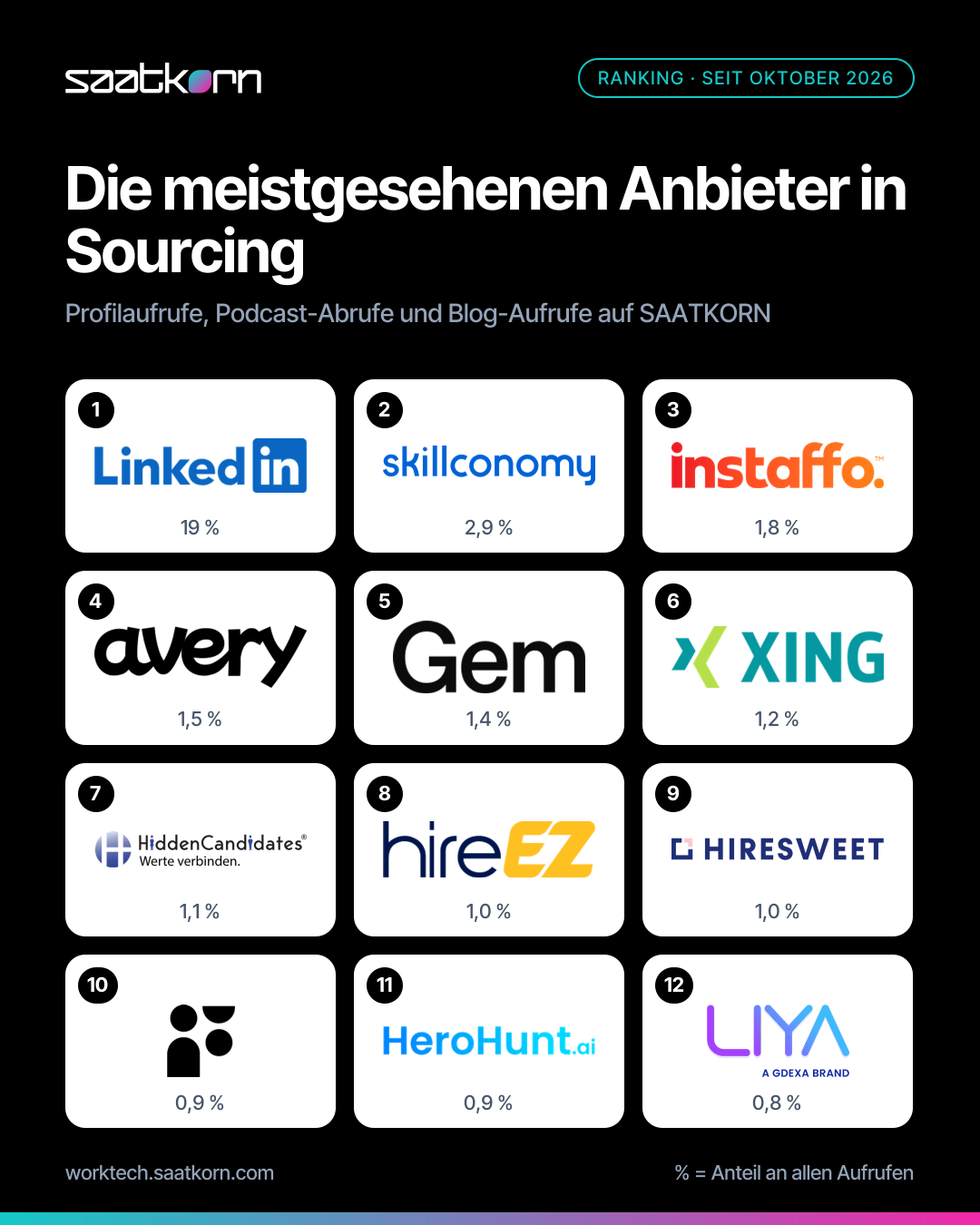
SAATKORN WorkTech Insights: Top 12 Sourcing Providerss
Source: SAATKORN WorkTech Insights, November 2026. The percentages refer to the underlying SAATKORN visibility metric, not to market share in the sourcing sector.
Content is King
Of course, LinkedIn benefits from its global brand recognition and its established position in the field of professional networking and recruitment. But there is another interesting aspect: the contribution of editorial content to providers’ visibility.
Britta Behrens was recently my guest on SAATKORN to discuss LinkedIn – this is the main reason why visibility on my platform is currently so high. This demonstrates how editorial presence can contribute to the discovery of technologies.
At the same time, skillconomy’s second-place ranking shows that specialist providers can attract attention alongside global technology brands. There are a large number of articles and podcasts featuring them on SAATKORN, ensuring they too enjoy good visibility.
Discover the entire SAATKORN WorkTech ‘Sourcing’ category
here.
What do the latest research findings say?
Recent scientific research and international industry studies provide some interesting insights:
AI speeds up the candidate search
According to TestGorilla’s report ‘Recruiting in the AI Era – 2026’, 72 per cent of US recruiters surveyed stated that AI speeds up the search for candidates.
In the UK, the corresponding figure was 58 per cent. The difference is interesting in itself. The impact of AI is not the same across all markets, organisations or recruitment processes.
Human-in-the-loop sourcing has a scientific basis
A particularly relevant academic contribution comes from Kaya and Bogers. Their 2026 study, entitled ‘Analyzing the Effects of a Human-in-the-Loop Candidate Recommendation Algorithm at Jobindex’, examines the use of algorithmic candidate recommendations in a real-world recruitment environment. The study covers 41,390 job vacancies over a period of 17 months.
What makes this study particularly relevant is its focus on the interaction between algorithmic recommendations and human recruitment expertise, rather than viewing AI as an isolated replacement for recruiters.
A second academic study by Alain Lacroux and Christelle Martin Lacroux, entitled ‘When Recruiters Meet Algorithms: Advice Taking and Bias in AI-Assisted Recruitment’ examines how recruiters respond to algorithmic recommendations and what challenges arise in terms of bias and judgement. A total of 1,208 recruiters took part in the study.
Taken together, these studies raise an important question: how do we design effective collaboration between humans and algorithms? – It is not enough simply to add a human approval step. HR professionals need the skills, information and authority to critically evaluate AI-generated recommendations.
Candidates still value human interaction
Amidst all the enthusiasm for the technological possibilities, another question arises: what do the people who come into contact with these technologies actually expect?
The ‘softgarden Candidate Experience Study 2026’ surveyed 3,163 people.
Two findings stand out in particular:
- 96.5 per cent consider respectful treatment during job interviews to be important or very important.
- 93.6% value personal and respectful communication.
These findings relate more to the candidate experience in a broader sense than specifically to active sourcing. Nevertheless, they are highly relevant to the design of AI-supported recruitment processes, as the ability to reach more people in less time does not automatically mean that the quality of interactions improves.
For HR, this raises the question of which tasks can be usefully automated and where human interaction offers genuine added value.
Technological efficiency and the quality of human interaction should not be seen as opposites.
The challenge lies rather in intelligently combining the two.
Sourcing providers: established providers and AI-native rising stars
The sourcing market is evolving away from individual search tools towards increasingly integrated, agent-driven talent acquisition platforms.
What makes this development particularly interesting is the competition between established providers with existing data and sales advantages and newer companies that have relied on AI from the outset.
Some examples of established players
LinkedIn’s greatest strategic advantage is its professional network and the data generated within it. With Hiring Assistant 2, announced in September 2026, LinkedIn is expanding its agent-based recruitment capabilities through improved memory, reasoning and personalisation.
The company reports that recruiters are four times more likely to contact candidates found via the Hiring Assistant than those found through traditional recruitment methods. Of course, this is a metric provided by the provider and not independent evidence of better recruitment outcomes. Nevertheless, this illustrates LinkedIn’s strategic direction.
skillconomy sets itself apart from the competition through a combination of proprietary, AI-powered contextual matching, personalised candidate engagement and direct ATS integration. Rather than simply providing recruiters with yet another sourcing tool, the German provider positions itself as an end-to-end sourcing solution. The company states that its AI identifies 30 per cent more top talent than manual sourcing.
Although this is a figure provided by the provider rather than independently validated data, skillconomy highlights an important shift in the market: away from active sourcing as a manual recruitment discipline towards AI-powered sourcing-as-a-service.
Instaffo is not a purely ‘traditional’ sourcing provider, but combines a curated talent marketplace with over 300,000 pre-qualified candidates with AI-powered matching and proactive sourcing functions. If asked, Instaffo would certainly classify itself as a sourcing provider, although the company also covers other areas. Its recruiting agent reviews applications and recommends suitable candidates, whilst employers can contact talent directly via the Talent Feed.
The company reports an average response rate of 30 per cent for proactive outreach. Even though this is a figure provided by the provider itself, Instaffo’s strategic positioning is compelling: It combines the reach of a job board, the precision of AI-powered sourcing measures and the success-based business model of traditional recruitment agencies.
Gem combines sourcing, recruitment CRM, talent intelligence and AI agents. The AI functions for rediscovering talent tap into an often underestimated potential: searching for relevant talent within a company’s existing applicant database. Why spend money on acquiring new applicant data when suitable candidates may already be present within the company’s own talent ecosystem?
With its EZ Agent, hireEZ positions itself as an agent-based recruitment platform covering sourcing, screening, candidate engagement and scheduling. The strategic direction is clear: moving away from individual sourcing activities towards coordinated recruitment processes.
SeekOut is another established provider of sourcing and talent intelligence solutions that is moving towards agent-based recruitment. Its development illustrates the convergence of talent search, candidate assessment and AI-powered outreach.
Some examples of AI-native rising stars
Juicebox is one of the particularly interesting providers in the field of AI-powered talent search that is worth keeping an eye on. Its natural language-based approach to talent search illustrates how traditional search interfaces are being replaced by more intuitive, AI-driven interactions.
HeroHunt.ai represents the new generation of AI-driven recruitment solutions, with a focus on automating talent search and outreach.
Ranked fourth in the SAATKORN visibility ranking, Avery is another provider to keep an eye on, as AI-powered recruitment solutions are becoming increasingly important.
What HR decision-makers should consider
In my view, the following questions are particularly relevant for HR executives when evaluating sourcing technologies:
- Data quality:
Where does the candidate information come from, and how accurate and up-to-date is it? - Autonomy:
Which tasks can the AI agent perform independently, and where is human approval required? - Integration:
How effectively can the solution be integrated into existing ATS, CRM and talent intelligence infrastructures? - Governance:
Can decisions be explained, reviewed and corrected? How does the solution handle data protection, bias and regulatory requirements? - Candidate experience:
Does the technology improve the quality of interactions, or does it merely increase their volume?
What does the SAATKORN community think?
I asked my LinkedIn community a simple question:
Will AI agents replace human active sourcers?
The results:
- 40 per cent – Yes, they will largely replace them.
- 60% – No, they will primarily support them.
This is, of course, just an informal poll and not a representative study. Nevertheless, I find the result remarkable: whilst the majority expect them to complement rather than replace human active sourcers, a significant proportion believe that human active sourcers will be largely replaced.
Personally, I believe that both viewpoints contain a grain of truth.
Certain sourcing activities will become increasingly less reliant on human execution. Some traditional sourcing roles could disappear or change significantly. At the same time, other skills are becoming more important: the ability to deploy AI agents in a targeted manner, to critically evaluate their results, to recognise connections and to make informed decisions.
Perhaps the crucial question, therefore, is not whether AI will replace human active sourcers. Rather, it is how AI will change the job profile of the active sourcer. And what role humans will ultimately play. I actually find Ahmet Cetiner’s comment under my little survey very apt: “If all the agents reach out at the same time, in the end it’s the one who picks up the phone who wins.
😄”
My view: When sourcing becomes a commodity, judgement becomes a key competence
I believe we are currently witnessing the beginning of a fundamental shift in the job profile within recruitment. And sourcing is perhaps one of the best examples of this.
For many years, a key part of a good active sourcer’s expertise lay in knowing where and how to find the right people. It is precisely this skill that is being increasingly democratised by agent-based AI. But what happens when virtually every recruitment team can identify hundreds of potentially suitable candidates and approach them in a personalised way within a matter of minutes?
Then the competitive advantage shifts.
It is no longer the ability to gather information, but the ability to interpret information, scrutinise it critically and use it to make the right decisions that becomes the key differentiating factor.
From Active Sourcer to Agentic Orchestrator
The active sourcer is increasingly becoming an agentic orchestrator: someone who manages AI agents, evaluates their results, recognises patterns and takes responsibility for the quality of the recruitment process. This has far-reaching consequences for HR. After all, it is not enough to invest in ever more powerful WorkTech solutions. We must invest at least as much in the skills of the people who work with these technologies.
And this also includes the willingness to consciously disagree with an AI-generated recommendation when there are good reasons not to accept it.
For me, sourcing is therefore also a harbinger of what we will experience in many other HR disciplines: a shift from operational execution towards technological orchestration and human judgement.
Judgement is the new competitive advantage
The more powerful the technology becomes, the more important the mindset of the people using it becomes.
For HR decision-makers, this also means rethinking the criteria for success when using WorkTech. The focus should not be on the number of automated processes, identified profiles or messages sent, but on the quality of the resulting decisions and outcomes. Those who merely automate existing processes unlock efficiency potential. Those who simultaneously rethink roles, skills and responsibilities have the opportunity to fundamentally transform HR.
And that brings us back to my motto:
“Technology changes what’s possible. Attitude determines the impact.”